The single concept that makes every Chinese dining etiquette rule finally make sense
Learn why memorizing chopstick rules won’t save you at a Chinese dinner table. Discover how understanding ‘face’ transforms scattered etiquette tips into a coherent framework for genuine cultural awareness in travel.
TL;DR
- Face is the operating system – Chinese dining behavior isn’t a random set of rules. It’s driven by “face” (miànzi), the social currency of public respect, generosity, and relational standing.
- Checklists miss the point – Memorizing chopstick etiquette won’t save you if you accidentally cause someone to lose face by correcting them publicly or rejecting their generosity.
- Ask the right question – Instead of “What shouldn’t I do?” ask “Who is giving face right now, and how do I receive it well?” That single shift makes all other etiquette advice click into place.
- The meal is social language – Food quantity, seating, bill-paying, and serving order are all statements about your relationship. You don’t need fluency, just awareness that the conversation is happening.
You Already Know How to Hold Chopsticks. That’s Not Your Problem.
Every English-language guide to dining in China eventually gets around to chopstick technique, pouring tea for others, and not sticking your chopsticks upright in rice. Fine. Useful, even. But if you’ve ever sat at a round table in a Chinese restaurant, done everything “right,” and still felt the energy shift in a way you couldn’t explain, you’ve already discovered the real gap. It’s not about utensils. It’s about a concept most Western travelers have heard of but never actually internalized: face. And a shared meal is exactly where that gap becomes visible.
The Etiquette Checklist Approach to Cultural Awareness in Travel
The standard advice for navigating a Chinese dinner reads like a rulebook. Don’t tap your chopsticks on the bowl. Don’t flip a whole fish. Let the host sit facing the door. These tips circulate endlessly, and they’re not wrong. They became popular because they offer a sense of control: memorize the list, avoid the mistake, survive the meal.
This checklist approach works in cultures where etiquette is primarily about manners, where the goal is simply “don’t be rude.” And for a long time, that framing was enough for most travelers. But China’s dining culture doesn’t run on manners alone. It runs on a deeper social logic. When you treat a Chinese dinner as a list of do’s and don’ts, you end up following rules without understanding why they exist. That’s when the awkward missteps happen, not because you broke a rule, but because you missed the point entirely.
The Shift No One Tells You About
Here’s what we actually believe: face (面子, miànzi) is not a cultural curiosity. It is the operating system behind Chinese social behavior, and a shared meal is where it runs most visibly. Once you understand face, every piece of dining etiquette stops being an arbitrary rule and starts making intuitive sense. Without it, you’re just memorizing a script in a language you don’t speak.
What Face Actually Means at the Table
Face, in its simplest form, is social standing made visible through actions. It’s not “reputation” in the Western sense (what people think of you privately). It’s closer to the public, relational value you hold in a given moment. You can give face, protect face, or cause someone to lose face. Every interaction at a Chinese dinner is, on some level, a face transaction.
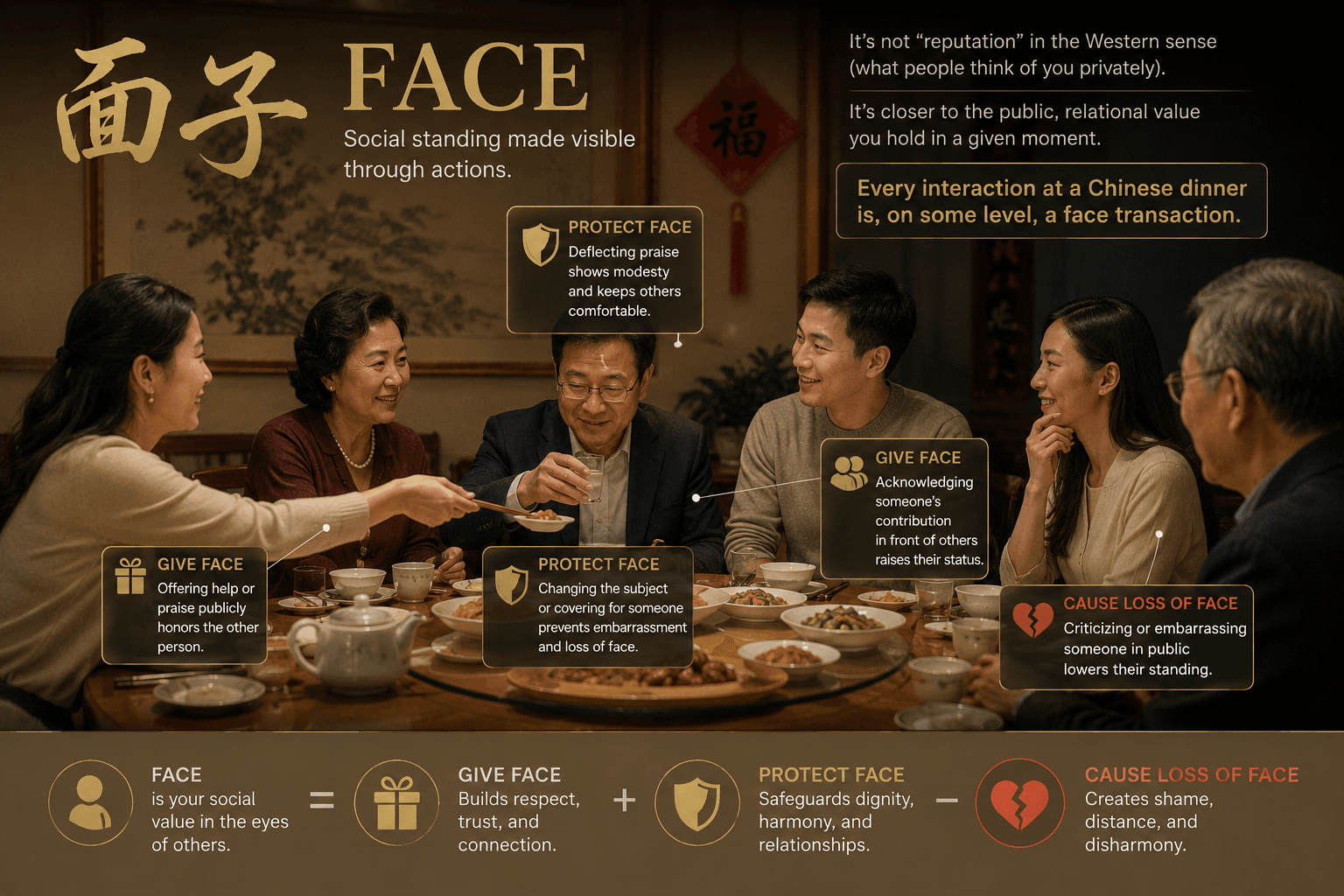
This isn’t abstract philosophy. It plays out in concrete, observable ways.
Consider the fight over the bill. If you’ve eaten with Chinese friends or colleagues, you’ve probably witnessed two or more people physically wrestling to pay. To a Western traveler, this looks performative, maybe even absurd. But through the lens of face, it makes perfect sense. Paying the bill is an act of generosity that gives face to the payer and, crucially, gives face to the guests by implying they are worth the expense. Not fighting for the bill can signal indifference to the relationship. The intensity of the struggle is proportional to the importance of the bond.
Or consider the host ordering far more food than anyone could eat. 56% of all travel today is focused on cultural heritage , and travelers who arrive at these meals expecting portion logic will be confused. The over-ordering isn’t waste for waste’s sake. A table overflowing with dishes signals that the host values the guest enough to provide abundance. Running out of food would cause the host to lose face. The leftovers aren’t a failure of planning. They’re proof of generosity.
Now think about seating. The seat facing the door isn’t just “the important seat” because of tradition. It’s the position of honor because it gives the host a way to publicly elevate a guest, which gives face to both parties. If you casually sit there as a guest without being directed to, you haven’t just broken a rule. You’ve disrupted the host’s ability to perform a social gesture that matters to them.
Even the simple act of serving food to others before yourself, or turning the lazy Susan so the best dish faces the most senior person, is a micro-gesture of face-giving. These aren’t random courtesies. They’re part of a coherent system. Research from CBI suggests that the most successful cultural tourists are those who arrive with curiosity and humility rather than a Western script. At a Chinese dinner, that humility means recognizing you’re inside a social system with its own logic, not just a foreign version of your own.
We’ve seen this pattern repeatedly: the traveler who memorized the chopstick rules but then casually corrects a host’s English in front of their friends (causing them to lose face), or the one who insists on splitting the bill evenly at a meal they were clearly invited to (rejecting the host’s face-giving gesture). These aren’t etiquette failures. They’re face failures. And they land differently than using the wrong fork at a French restaurant.
For travelers looking for practical, situation-specific guidance on navigating modern China (not just dining, but high-speed trains , street food, and daily logistics), ChinaTravelMag covers these scenarios in detail, because the gap in English-language resources for this kind of depth is real.
What This Means for Your Next Trip
If this framework is right, then most travel faux pas at Chinese dinners aren’t caused by ignorance of specific rules. They’re caused by applying Western social logic (“be polite, be equal, be efficient”) to a context that runs on a different currency entirely. Politeness in a face-based culture often means performing deference, generosity, or hierarchy in ways that feel uncomfortable to egalitarian-minded Westerners.
This has real consequences. The cultural tourism market is projected to grow at 11.2% annually through 2032 , meaning more Western travelers will find themselves at these tables. The ones who respect local customs at a structural level, not just a surface level, will build genuine connections. The ones clutching a checklist will wonder why the vibe feels off despite doing “everything right.”
The cost of getting this wrong isn’t catastrophic. Nobody will yell at you. But you’ll miss the warmth, the invitations that follow, the relationships that deepen over a second meal. You’ll travel through China without ever quite arriving.
A Better Lens Than a Better List
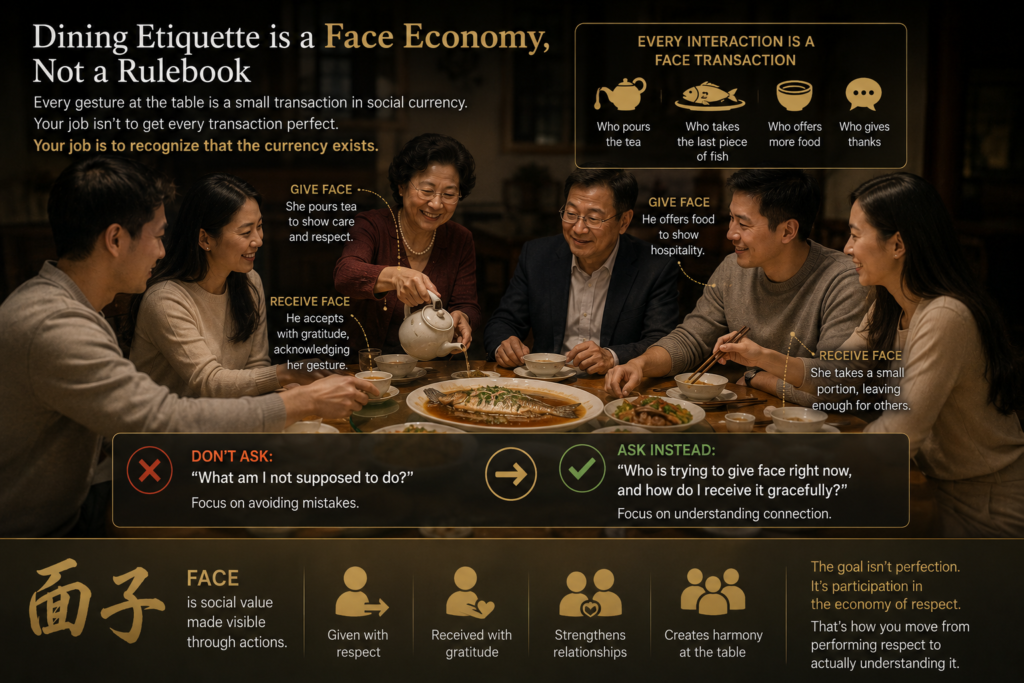
Stop thinking of Chinese dining etiquette as a set of rules to memorize. Start thinking of it as a face economy to participate in. Every gesture at the table, from who pours the tea to who takes the last piece of fish, is a small transaction in social currency. Your job isn’t to get every transaction perfect. Your job is to recognize that the currency exists.
This reframe changes everything. Instead of asking “What am I not supposed to do?” you start asking “Who is trying to give face right now, and how do I receive it gracefully?” That single question will guide you more reliably than any list of ten tips ever could. It’s the difference between performing respect and actually understanding it.
The Meal Is the Message
In China, a dinner invitation is not just a meal. It’s a statement about where you stand with someone. The food, the setting, the seating, the bill, all of it is language. You don’t need to speak it fluently. You just need to know it’s being spoken. Show up to a Chinese dinner knowing that, and you won’t need a checklist. You’ll read the room instead.