The pre-loaded knowledge local audiences already have — and how to walk in with it yourself
Learn the specific visual, musical, and behavioral cues that make Sichuan opera and Chinese folk performances legible to local audiences. This guide gives foreign travelers the interpretive framework to move from confused spectator to engaged witness.
TL;DR
- Pre-load specific context, not general culture — Learn the face paint meanings, character types, and story summaries for the exact performance you’re attending. Twenty minutes of targeted research transforms the experience.
- Follow the percussion, not the words — You won’t understand the dialogue, and that’s fine. Drums, cymbals, and woodblocks encode the emotional and narrative arc of every scene. Train your ear on the rhythm section and your comprehension jumps dramatically.
- Use the local audience as your decoder — Watch when they shout “hǎo,” lean forward, or laugh. Their reactions tell you what just happened and what mattered. Join in when the timing feels right.
- Arrive early, stay until the end — The 20 minutes before the show teaches you the venue’s norms. The final segments (especially face-changing in Sichuan opera) are the climax. Leaving early means missing the point.
- Debrief immediately after — Write down what engaged you, what confused you, and one audience behavior that surprised you. This converts a fleeting experience into lasting cultural understanding.
Guide Orientation: What This Covers and Who It’s For
This guide gives you the cultural context in travel that transforms a confusing evening at a Chinese performance into one you actually understand. It covers Sichuan opera (chuanju), regional folk shows, acrobatic performances, and the immersive dinner-theater experiences increasingly popular in cities like Chengdu and Chongqing.
It’s written for foreign travelers (primarily from North America and Europe) who want more than a photo op. You don’t need Mandarin fluency or a degree in Chinese theater. You need to know what to watch for, when the audience expects a reaction, and what the performers are signaling.
By the end, you’ll be able to identify key performance conventions, respond at the right moments, decode visual and musical cues, and avoid the behaviors that mark you as someone who wandered in by accident. This guide does not cover Chinese cinema, modern theater, or concert etiquette. It focuses on traditional and folk performance forms where the gap between tourist confusion and local understanding is widest.
Why Reading the Room at Chinese Performances Matters
Cultural performances in China aren’t designed for passive consumption. They evolved inside communities where the audience already knew the stories, recognized the character archetypes from their face paint, and understood that a specific percussion pattern meant a battle was coming. When you sit down without that pre-loaded context, you’re not watching the same show as the person next to you.
This matters more than it might seem. 79% of travelers say travel expands their worldview , but expansion requires comprehension, not just exposure. Sitting through a 90-minute Sichuan opera feeling lost doesn’t broaden your perspective. It just makes you tired.
The global cultural tourism market was valued at USD 7.25 billion in 2024 and is projected to more than double by 2032. More travelers are seeking meaning-rich experiences. But the infrastructure for helping foreigners decode those experiences in China remains thin. Most English-language guides tell you to “keep an open mind” or “embrace the unfamiliar.” That’s not a strategy. It’s a platitude.
The cost of showing up unprepared isn’t just your own confusion. It’s the phone that lights up during a quiet passage, the applause at the wrong moment, the early exit that disrupts a row. With a small amount of preparation, you move from being a well-meaning obstacle to someone the audience beside you respects.
Core Concepts: What You Need to Know Before You Go
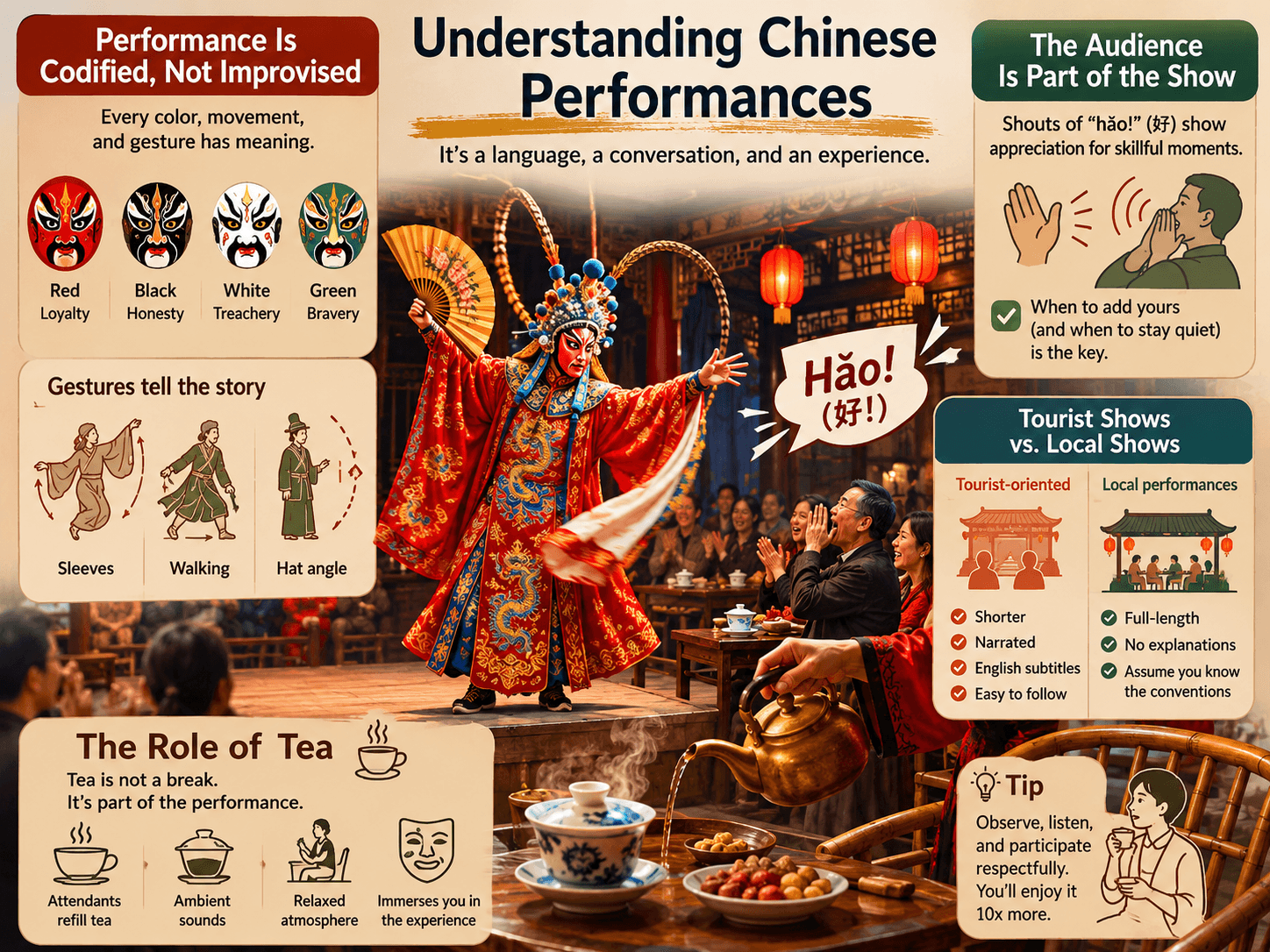
Performance Is Codified, Not Improvised
Most traditional Chinese performances operate on a system of conventions, not spontaneous expression. Face paint colors in Sichuan opera correspond to character traits: red for loyalty, black for honesty, white for treachery. Sleeve movements, walking patterns, and even the angle of a hat communicate plot information. This is closer to reading a language than watching a movie.
The Audience Is Part of the Show
In Western theater traditions, the audience is typically silent until applause. In many Chinese performance forms, the audience participates vocally. Shouts of “hǎo!” (好, meaning “good!” or “bravo!”) punctuate skillful moments. This isn’t heckling. It’s the equivalent of a standing ovation compressed into a single syllable, delivered in real time. Knowing when to add yours (and when to stay quiet) is the single biggest behavioral cue that separates a prepared visitor from a confused one.
Tourist Shows vs. Local Shows
There’s a meaningful distinction between performances staged primarily for tourists and those attended by local audiences. Tourist-oriented shows (common in Chengdu’s Jinli district, for example) are shortened, narrated, and sometimes include English subtitles. Local performances, found in teahouses or community theaters, assume you know the conventions. Both are worth attending, but they require different levels of preparation. This guide prepares you for both, with emphasis on the local experience where the gap is largest.
The Role of Tea
In Sichuan opera teahouse performances, tea service is not intermission refreshment. It’s woven into the experience. Attendants refill cups during the show. The clinking of lids, the pouring, the ambient noise of a teahouse is the intended atmosphere, not a distraction. Adjusting your expectations here prevents frustration before it starts.
The Framework: Four Phases of Engaged Attendance
Reading the room at a Chinese cultural performance isn’t one skill. It’s four, applied in sequence. Think of it as a preparation-to-reflection cycle:
- Phase 1: Pre-Load — Acquire the specific context the performance assumes you already have.
- Phase 2: Calibrate — Arrive early and observe the venue, the audience, and the setup to adjust your expectations.
- Phase 3: Track — During the performance, follow specific visual, musical, and audience cues rather than trying to understand every word.
- Phase 4: Process — After the show, consolidate what you noticed and fill gaps while the experience is fresh.
Each phase builds on the previous one. Skipping Phase 1 makes Phase 3 nearly impossible. The steps below break each phase into concrete actions.
Step-by-Step: How to Read the Room at a Chinese Cultural Performance
Step 1: Research the Specific Performance Form (Pre-Load)
Objective: Arrive knowing the basic story structure, character types, and signature techniques you’ll encounter, so your brain can pattern-match during the show instead of scrambling to orient itself.
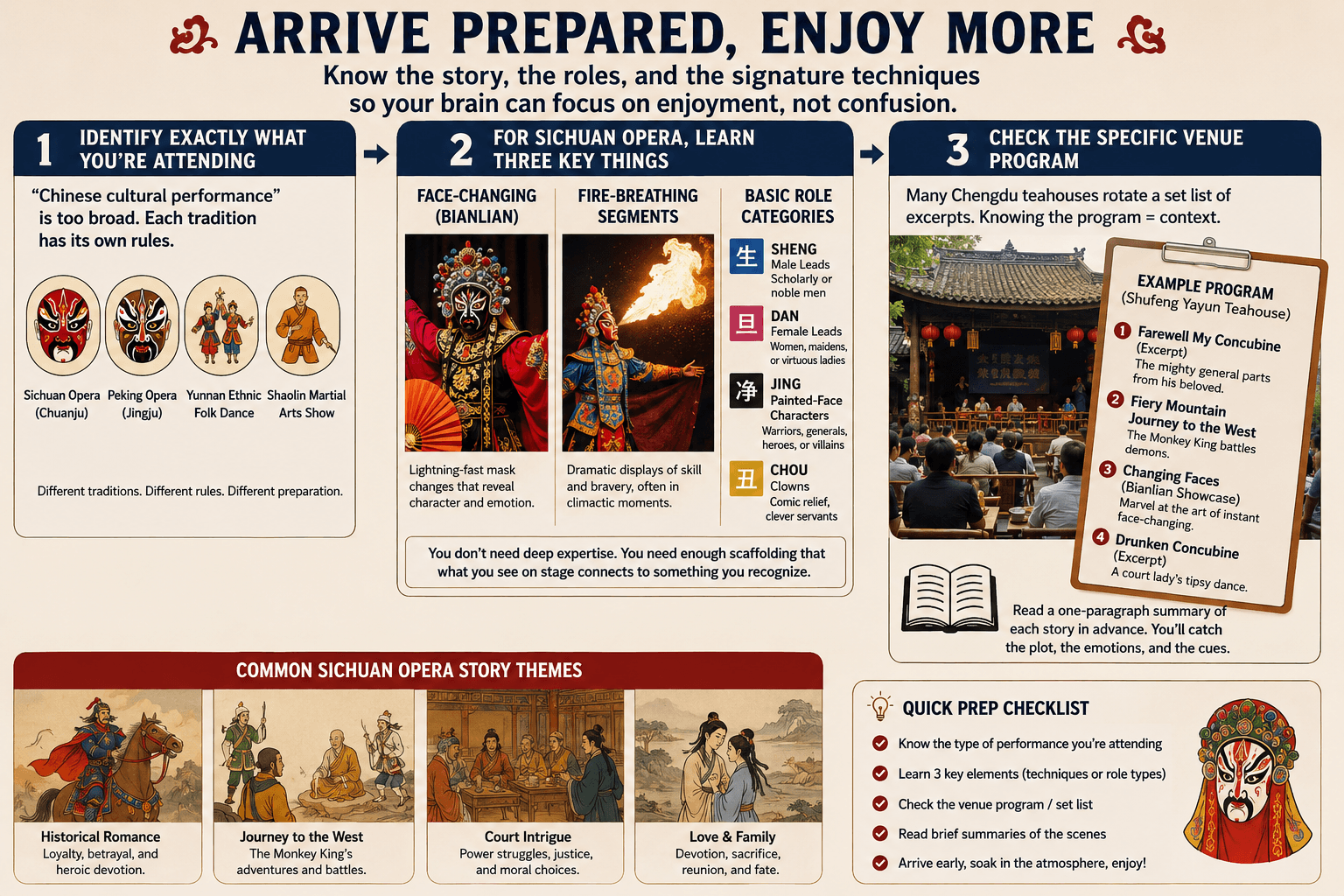
Start by identifying exactly what you’re attending. “Chinese cultural performance” is too broad to prepare for. Sichuan opera (chuanju) is different from Peking opera (jingju), which is different from a Yunnan ethnic minority folk dance, which is different from a Shaolin martial arts demonstration. Each has its own rules.
For Sichuan opera specifically, learn three things before you go: the face-changing technique (bianlian), the fire-breathing segments, and the basic role categories (sheng for male leads, dan for female leads, jing for painted-face characters, chou for clowns). You don’t need deep expertise. You need enough scaffolding that what you see on stage connects to something you recognize.
Search for the specific venue’s program if possible. Many Chengdu teahouses like Shufeng Yayun rotate a set list of excerpts. Knowing which scenes are on the program lets you read a one-paragraph summary of each story in advance.
Anti-patterns: Don’t try to learn everything about Chinese opera history. You’ll overwhelm yourself and retain nothing useful. Don’t rely on a general “Chinese culture” article. The specificity matters.
Success indicators: You can name the performance form, identify at least three visual conventions (e.g., face paint meanings, sleeve gestures), and summarize the plot of at least one piece on the program.
Step 2: Arrive Early and Read the Physical Space (Calibrate)
Objective: Understand the venue’s social dynamics, seating logic, and behavioral norms before the performance begins.
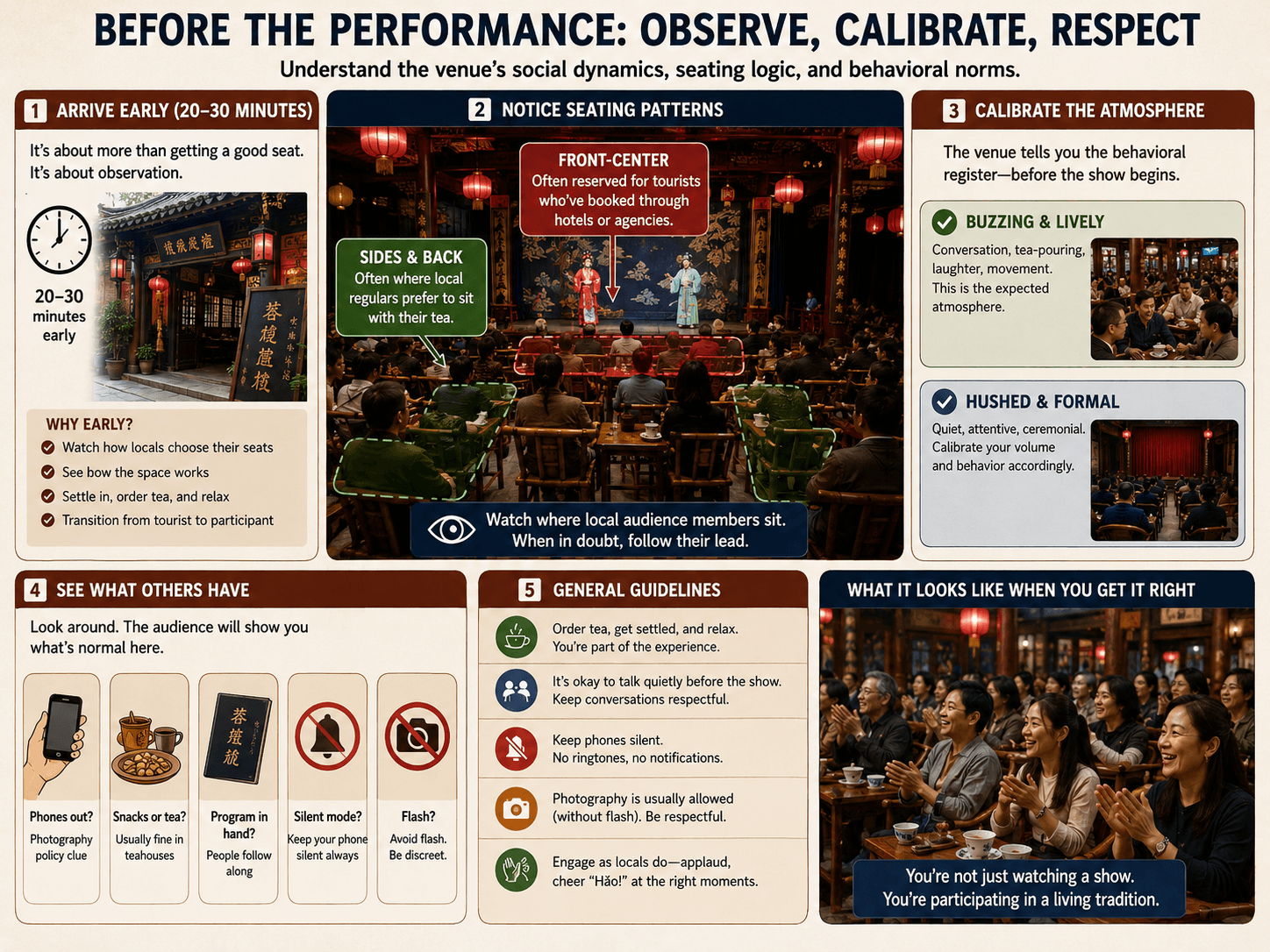
Get there 20 to 30 minutes early. This isn’t about getting a good seat (though it helps). It’s about observation. Watch where local audience members sit. In teahouse performances, regulars often have preferred spots. Front-center seats are sometimes reserved for tourists who’ve booked through hotels. Seats along the sides or toward the back are often where experienced local audience members settle in with their tea.
Notice the noise level. If the room is buzzing with conversation and tea-pouring, that’s the expected atmosphere, not a sign that the show hasn’t started yet. If the room is hushed and formal, calibrate accordingly. The venue tells you the behavioral register before a single performer appears.
Look at what other audience members have with them. Phones out? Snacks? Programs? This tells you the venue’s norms around photography, eating, and engagement. Some tourist-oriented venues encourage photography. Local teahouse performances generally tolerate it but expect you to keep your phone silent and avoid flash.
If you’re navigating to the venue by public transit, our Chinese metro guide covers everything from security screening to Alipay QR payments so you arrive without logistical stress.
Anti-patterns: Don’t arrive right at showtime and squeeze past seated audience members. Don’t assume Western theater norms (silence, darkness, fixed seating) apply universally.
Success indicators: Before the show starts, you can describe the venue’s formality level, you know whether photography is acceptable, and you’ve noticed at least one behavioral norm from watching other audience members.
Step 3: Follow the Percussion, Not the Dialogue (Track)
Objective: Use musical cues as your primary navigation system through the performance, since you likely won’t understand the sung or spoken text.
This is the most important reframe for non-Chinese-speaking audience members. You will not understand the words. That’s fine. Traditional Chinese performance forms encode enormous amounts of information in the music, particularly the percussion. A rapid drumbeat signals combat or urgency. A slow, sparse rhythm with woodblock accents often accompanies emotional reflection or a character’s internal monologue. Cymbal crashes mark dramatic entrances and exits.
Train your ear on the percussion section (usually visible at the side of the stage) during the first few minutes. Once you start hearing the tempo and intensity shifts, you’ll find that your emotional response to the performance starts aligning with the audience around you. This is the single most effective technique for closing the comprehension gap without language.
The string instruments (erhu, pipa) carry melodic and emotional information too, but percussion is more immediately legible to an untrained ear. Think of it as the performance’s emotional subtitle track.
Anti-patterns: Don’t fixate on trying to understand lyrics or dialogue. You’ll exhaust your attention in the first 15 minutes and disengage. Don’t ignore the musicians. In many venues, they’re visible and their coordination with the stage action is part of the artistry.
Success indicators: Within 10 minutes, you can predict the general emotional tone of a scene shift based on the percussion pattern. You notice your attention tracking the music rather than straining at the words.
Step 4: Watch the Audience for Reaction Cues (Track)
Objective: Use the local audience as a live decoder ring for when to react, how to react, and what just happened that was significant.
The audience around you (particularly older regulars at teahouse performances) is your most valuable resource. They will shout “hǎo!” at moments of technical virtuosity. They’ll lean forward during tense passages. They’ll laugh at comedic timing you might miss. Your job is not to mimic them robotically, but to use their reactions as data.
When you hear a collective “hǎo!” pay attention to what just happened on stage. Was it a vocal flourish? A sudden costume change? A martial arts move? Over the course of a performance, you’ll start to build an internal map of what this audience values and rewards. That map is the cultural context you came for.
Joining in with a “hǎo!” of your own is welcome, but timing matters. It comes at the peak of the moment, not after. If you’re a beat late, just listen. A well-timed “hǎo” from a foreign visitor genuinely delights performers and audience members alike. A poorly timed one is just noise.
23% of global leisure travelers say they travel specifically for culture and history. But culture isn’t absorbed passively. It’s decoded through active, responsive attention, and the audience is your guide.
Anti-patterns: Don’t clap during quiet, emotional passages just because a visual effect impressed you. Don’t applaud between scenes if no one else does. Don’t sit stone-faced through the entire show out of fear of doing something wrong.
Success indicators: By the second half of the performance, you’re anticipating audience reactions before they happen. You’ve contributed at least one appropriately timed response.
Step 5: Decode the Visual Vocabulary in Real Time (Track)
Objective: Apply the visual conventions you pre-loaded (Step 1) to identify characters, relationships, and plot developments as they unfold.
Now your preparation pays off. When a character enters with a white-painted face, you know this is likely an antagonist or morally ambiguous figure. When a performer uses exaggerated sleeve movements (shuixiu), you recognize this as emotional expression, not random fabric-waving. When the famous face-changing sequence begins in Sichuan opera, you’re watching the technique rather than just the spectacle.
Pay particular attention to entrances and exits. In traditional Chinese theater, how a character enters the stage (which side, what pace, with what accompanying music) tells you their status and intention. A general enters differently from a scholar. A ghost enters differently from a living character. These conventions are remarkably consistent across performances, so once you learn them, they transfer.
For immersive dinner-theater experiences (increasingly popular in cities like Chongqing), the visual vocabulary extends to the entire environment. If you’re considering something like the Huayan Banquet immersive dining show , the costuming, room design, and even the food presentation carry narrative meaning.
Anti-patterns: Don’t treat the performance as abstract visual art. It’s narrative. Everything on stage means something specific. Don’t ignore costumes and props in favor of watching only faces.
Success indicators: You can identify at least two characters by their visual coding (face paint, costume, movement style) and have a rough sense of their role in the story.
Step 6: Manage Your Technology Respectfully (Track)
Objective: Document the experience without disrupting it for performers or other audience members.
Phone etiquette at Chinese performances is more nuanced than a blanket “no phones” rule. At tourist-oriented venues, photography and even video are often explicitly permitted (sometimes encouraged, since it drives social media promotion). At local teahouse performances, the norms are looser than Western theaters but stricter than you might assume.
The general rule: short video clips and photos without flash are usually tolerated. Holding your phone above your head to record blocks sightlines and draws visible irritation. Extended recording (filming an entire 10-minute segment) is poor form even where it’s technically allowed. The performers can see your screen. A phone held up for the duration of a piece communicates that you’re collecting content, not watching the show.
If you want a good photo of the face-changing sequence, have your camera app open and ready before it begins (it’s usually near the end of the program). Take a few shots and put the phone down. You’ll remember more of the actual moment than the screen version.
Make sure your essential apps are set up before you leave the hotel so you’re not fumbling with Alipay or translation tools during the show.
Anti-patterns: Don’t use flash. Ever. Don’t record with your phone held high for extended periods. Don’t assume that because one person is filming, everyone can. Some audience members may be regulars with an understood relationship with the performers.
Success indicators: You captured 2 to 3 meaningful photos or a short clip without anyone visibly reacting to your phone. Your phone spent more time in your pocket than in your hand.
Step 7: Debrief While the Experience Is Fresh (Process)
Objective: Convert the raw experience into durable understanding by reflecting on what you noticed, what confused you, and what you’d do differently next time.
Within an hour of the performance ending, write down (or voice-record) three things: the moment that most engaged you, the moment that most confused you, and one audience behavior you noticed that surprised you. This simple exercise does more for cultural understanding than reading a textbook chapter on Chinese performing arts.
If you’re traveling with others, discuss what you each noticed. Different observers catch different things. One person might have tracked the music while another noticed the audience dynamics. Combining perspectives builds a richer picture.
If you’re eating after the show (likely, given the timing of most evening performances), this debrief pairs naturally with dinner. If you’re navigating Chinese dinner etiquette for the first time, that’s its own set of cultural cues worth understanding.
For deeper research after the fact, ChinaTravelMag publishes experience-specific guides that cover the behavioral and logistical details most English-language travel content skips entirely.
Anti-patterns: Don’t let the experience fade into a vague memory of “that opera thing we went to.” Don’t immediately post on social media without first processing what you actually experienced. The caption can wait.
Success indicators: You can articulate at least one specific thing you understood during the performance that you wouldn’t have grasped without preparation. You have a concrete idea of what you’d research before attending a second performance.
Practical Examples: Two Scenarios Compared
Scenario A: The Unprepared Tourist at Shufeng Yayun, Chengdu
Sarah books a Sichuan opera show at Shufeng Yayun because her hotel concierge recommends it. She arrives five minutes before curtain, sits in the front row (tourist section), and watches the show with genuine interest but no framework. The face-changing is spectacular, so she records most of it. The comedic segments get no reaction from her because she doesn’t understand the dialogue. The shadow puppetry segment feels slow. She leaves after 70 minutes thinking, “That was interesting, I guess.”
Sarah’s experience was fine. But she watched a highlight reel without context, reacted to spectacle alone, and missed the artistry in the segments that required cultural literacy. Her memory of the evening compresses to: face-changing was cool.
Scenario B: The Prepared Visitor at the Same Venue
James reads a one-page overview of Sichuan opera conventions the morning of the show. He learns that bianlian (face-changing) uses silk masks pulled by hidden strings, that the rolling lamp act (gundengshu) involves a performer balancing oil lamps while contorting, and that the comedic segments often satirize local social dynamics. He arrives 25 minutes early, orders tea, and watches the regulars settle in. He notices an older man in the third row who seems to know every performer.
During the show, James follows the percussion. He catches the tempo shift before a dramatic reveal. When the comedian delivers a punchline and the local audience erupts, James doesn’t understand the words but reads the timing and laughs with them. He shouts “hǎo!” after a particularly acrobatic sleeve maneuver, and the woman next to him smiles and nods. He takes four photos total. He leaves after the full program feeling like he participated in something, not just observed it.
Same venue. Same show. Radically different experiences. The difference was 30 minutes of preparation and a framework for active engagement.
Unique Travel Experiences: Common Mistakes and Pitfalls
The most common mistake isn’t rudeness. It’s passivity. Foreign visitors default to “respectful silence” because they’re afraid of doing something wrong. In performance contexts where audience participation is expected, silence reads as disengagement, not respect.
The second most common mistake is treating the performance as a photo opportunity rather than a live event. If you spend 40% of the show looking at your phone screen, you’ve paid for a seat but attended a different show.
Third: leaving early. Many performances build toward their most impressive segments (bianlian in Sichuan opera is almost always near the end). Leaving at the 60-minute mark because you feel you’ve “gotten the idea” means you missed the climax and disrupted the row.
Finally, comparing the experience unfavorably to Western performing arts in real time (“this isn’t like Broadway”) prevents you from engaging with the form on its own terms. Research on cross-cultural tourist behavior confirms that cultural framing significantly shapes how travelers perceive and evaluate experiences. Awareness of your own frame is the first step to setting it aside.
What to Do Next
You don’t need to become an expert in Chinese performing arts. You need to do Step 1 (pre-load) for one specific performance, then attend it with the tracking framework from Steps 3 through 5 in mind. That’s it. One prepared attendance will teach you more than ten articles.
If you’re heading to Chengdu, look up the current program at Shufeng Yayun or Jinjiang Theater. If you’re in Beijing, the Liyuan Theatre or Huguang Guild Hall are accessible starting points. Spend 20 minutes reading about the specific form you’ll see. Arrive early. Watch the audience. Follow the drums.
The next time you sit in that teahouse, tea in hand, and the percussion kicks in, you won’t be wondering what you’re supposed to feel. You’ll know what to watch for. And when the moment comes, you’ll be ready with your “hǎo.”
Frequently Asked Questions
Sources
- https://www.statista.com/chart/31329/travel-for-the-soul/
- https://chinatravelmag.com/chinese-metro-guide-security-alipay-escalator-rules-local-tips/
- https://yougov.com/articles/46792-uncovering-insights-cultural-wanderlust-traveler-segmentation
- https://chinatravelmag.com/chongqing-liyan-baguo-huayan-banquet-etiquette-of-the-eight-kingdoms/
- https://chinatravelmag.com/the-essential-apps-that-replace-your-credit-cards-google-maps-and-english-menus-before-you-leave-the-hotel/
- https://chinatravelmag.com/chinese-dinner-etiquette-a-step-by-step-guide/
- https://www.chinatravelmag.com
- https://ijcsrr.org/cultural-differences-in-tourist-behavior-a-cross-cultural-psychological-study/