How online travel agencies charge more on the English side — and when switching to the Chinese app is worth it
Discover where Trip.com and Ctrip prices diverge despite sharing the same parent company and inventory. This comparison breaks down markup patterns, default add-ons, and fee structures to help you decide which app saves more.
TL;DR
- Same inventory, different price — Trip.com and Ctrip pull from identical hotel and flight databases, but the English-side app can cost 5–30% more on domestic budget and midrange bookings due to payment processing, currency conversion, and service fee layers.
- Premium hotels are usually the same price — International chains enforce rate parity, so the gap narrows to near-zero for high-end properties. The markup hits hardest on local guesthouses and domestic chains.
- Ctrip saves money, Trip.com saves headaches — Use Ctrip for straightforward domestic bookings if your Alipay works. Use Trip.com when you need English customer support, especially for cancellations or complex itineraries.
- Watch the checkout screen on both apps — Pre-checked add-ons (insurance, priority boarding, cancellation protection) inflate totals on both platforms, but Trip.com’s English interface tends to bundle more aggressively.
- Keep both apps installed — There’s no lock-in and minimal switching cost. Choose per booking based on what you’re buying and how much support risk you’re willing to accept.
Trip.com vs. Ctrip: Same Company, Different Price Tags
If you live in China and book travel through online travel agencies, you’ve probably noticed something odd. Trip.com (the English-language app) and Ctrip (携程, the Chinese-language app) are owned by the same parent company, pull from the same hotel and airline inventory, and yet regularly show different prices for the same room or seat. This isn’t a glitch.
The price gap matters most to expats and long-term residents who can technically use either app. You have a Chinese phone number, maybe an Alipay account, and enough Mandarin to stumble through an interface. The question is whether the effort of booking on the Chinese side is worth the savings, or whether the English side’s convenience justifies paying more.
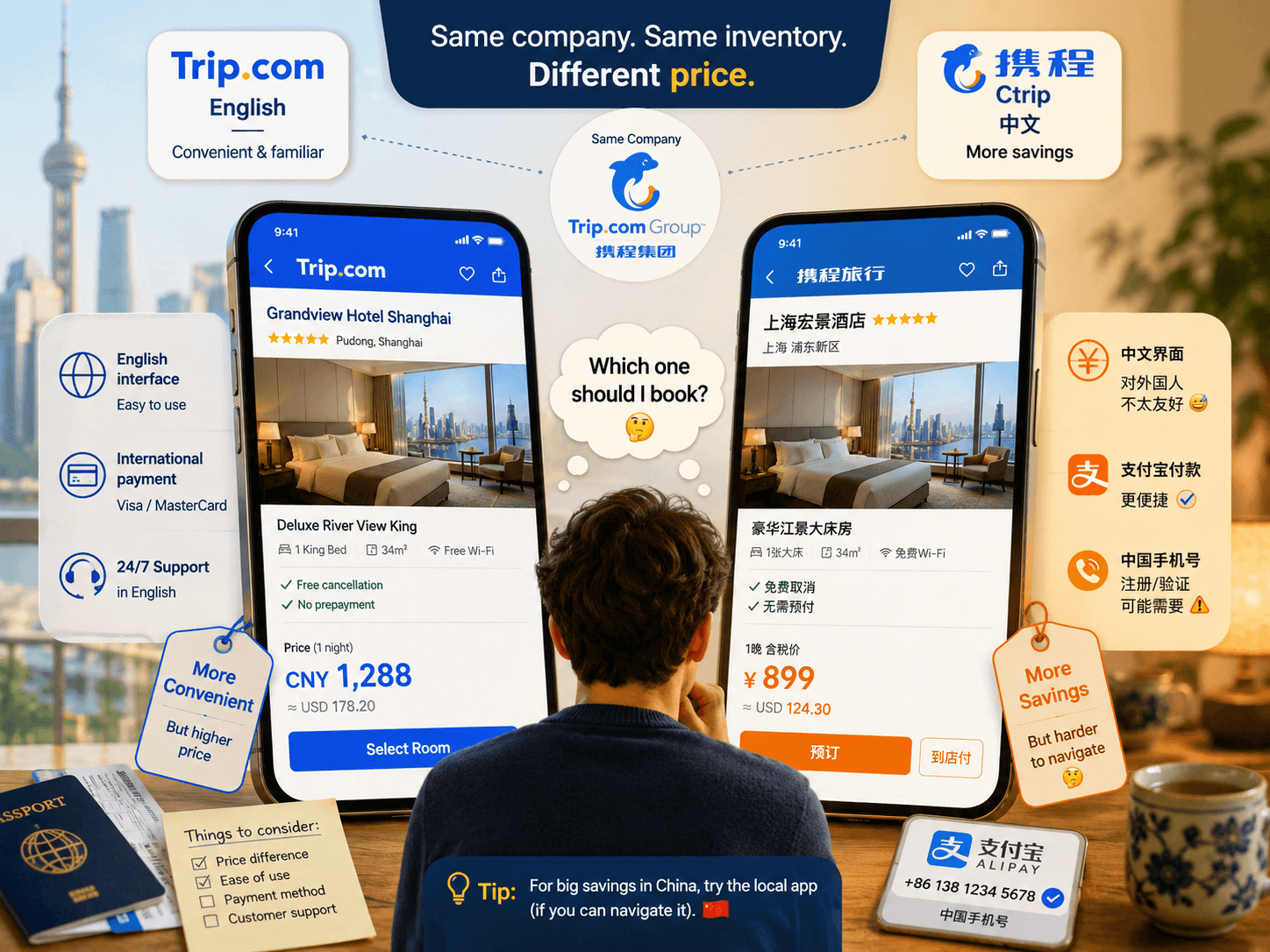
This comparison breaks down exactly where the costs diverge, what you’re actually paying for on each side, and when it makes sense to switch.
Quick Verdict: When to Use Which
Use Ctrip (Chinese app) if you have Alipay or WeChat Pay set up, can navigate basic Mandarin interfaces (or use a translation app), and are booking domestic flights, trains, or mid-range to budget hotels. The savings are real, especially on budget properties.
Use Trip.com (English app) if you need English-language customer support, are booking international flights with complex itineraries, or prefer paying with a foreign credit card without friction. The markup is the price of convenience.
| Criterion | Trip.com (English) | Ctrip (Chinese) | Winner |
|---|---|---|---|
| Base pricing (domestic hotels) | 5–30% higher on budget/midrange | Lower, especially for local chains | Ctrip |
| Base pricing (premium hotels) | Often identical | Often identical | Tie |
| Service fees | Variable, can be higher | Lower or absent | Ctrip |
| Payment flexibility | Visa, Mastercard, PayPal | Alipay, WeChat Pay, UnionPay | Trip.com (for foreigners) |
| Interface & language | Full English | Mandarin only | Trip.com |
| Customer support | English 24/7 | Mandarin only | Trip.com |
| Add-on defaults | More pre-checked extras | Fewer pre-checked extras | Ctrip |
| Domestic promotions | Rarely surfaced | Frequent flash sales, coupons | Ctrip |
Evaluation Criteria: What Actually Drives the Price Gap
Before diving into each dimension, it helps to understand why these criteria matter. The gap between Trip.com and Ctrip isn’t a single markup. It’s the accumulation of several small cost layers and design choices.
- Base fare/rate differences — The starting price before any fees. This is where currency conversion buffers and domestic-only promotions create the most visible gap.
- Service fees — Trip.com discloses that service fees cover reservation handling, payment processing, 24/7 support, and ticket management, and that these fees can be higher for international bookings.
- Payment processing — Foreign credit cards cost more to process than Alipay. That cost gets passed along.
- Add-on defaults — Pre-checked insurance, seat selection, and “fast booking” options inflate the checkout total if you don’t uncheck them.
- Promotions and coupons — Ctrip’s domestic interface regularly surfaces RMB-denominated flash deals and loyalty coupons that the English side simply doesn’t show.
- Support infrastructure — English-language customer service costs more to staff. That overhead is baked into the international product.
- Interface friction — How hard is it to actually complete a booking? For non-Mandarin speakers, this is a real cost measured in time and frustration.
Head-to-Head Breakdown: Trip.com vs. Ctrip for Flight Aggregators and Hotels
Base Pricing: Where the Real Money Gap Lives
The pricing difference depends heavily on what you’re booking. For premium international hotels, the gap is often negligible. A side-by-side comparison found that The Peninsula Shanghai showed virtually identical pricing on both platforms: about $450 USD on Trip.com and ¥3,200 RMB (roughly the same) on Ctrip.
Move down to midrange domestic chains and the picture changes. The same comparison found Atour Hotel Chengdu was about 10% cheaper on Ctrip ($58 USD equivalent vs. $65 on Trip.com). For a budget guesthouse in Yangshuo, the gap widened to roughly 30%: ¥180 RMB on Ctrip (about $25) versus $35 on Trip.com.
The pattern is consistent: the more “domestic” and budget-oriented the property, the larger the markup on the English side. International chain hotels tend to enforce rate parity, which keeps prices aligned. Local guesthouses and budget hotels have no such obligation.
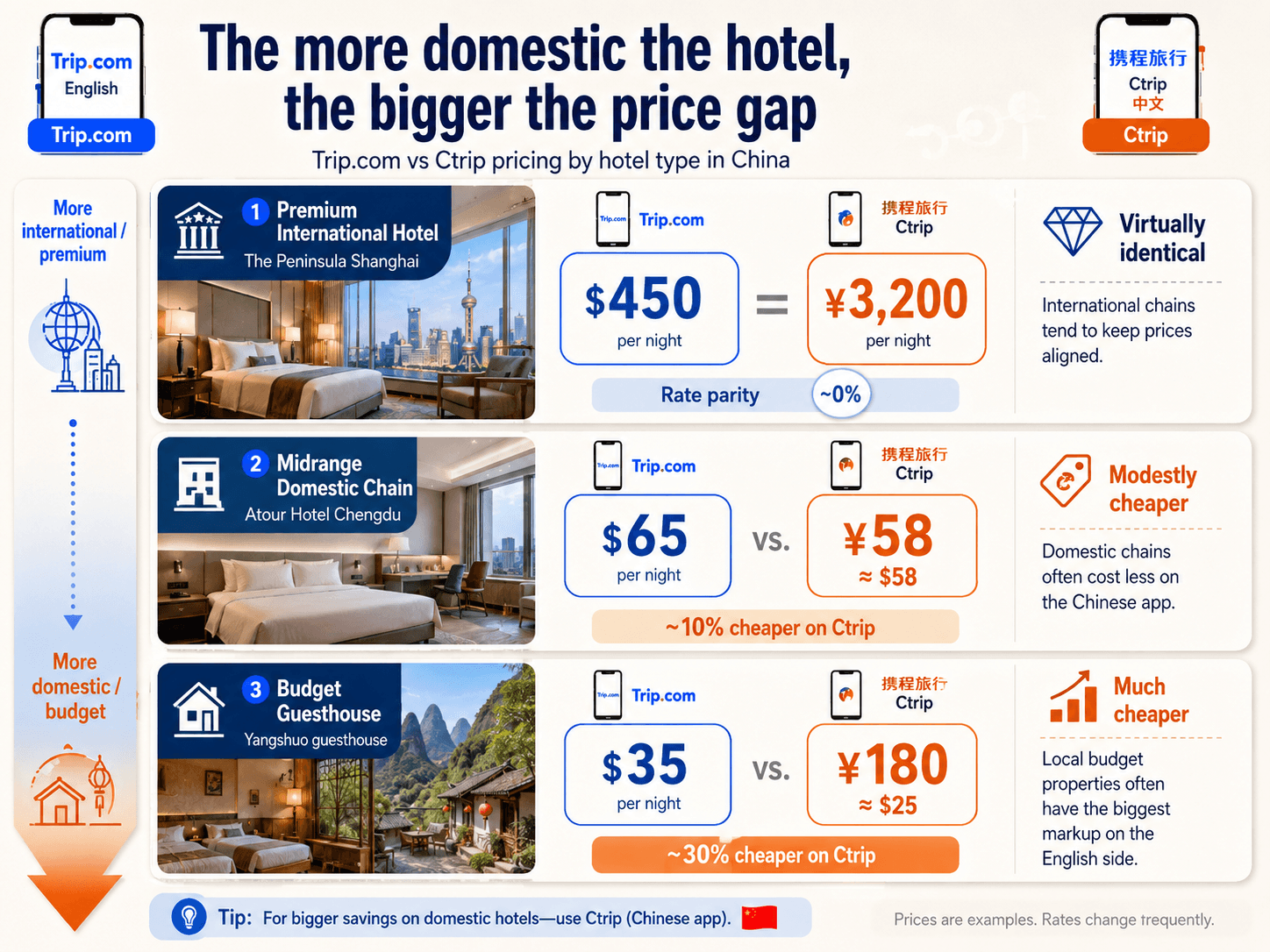
Verdict: Ctrip wins clearly on domestic budget and midrange bookings. For international chains, it’s a wash.
Service Fees and Hidden Costs
Trip.com’s own fee guide states that service fees are not fixed and can be higher for international and last-minute bookings due to “additional processing and payment complexity.” This is the company explicitly telling you that the English-side experience carries a surcharge.
Ctrip’s domestic app generally charges lower service fees, and for many standard domestic bookings (especially trains and budget hotels), the fee is negligible or zero. The Chinese app also tends to show the all-in price more transparently, partly because Chinese consumer protection norms around price display are strict.
On Trip.com, watch the checkout screen carefully. Fees for “booking confirmation,” “service guarantee,” or “express processing” can appear as line items that don’t exist on the Ctrip side for the same product.
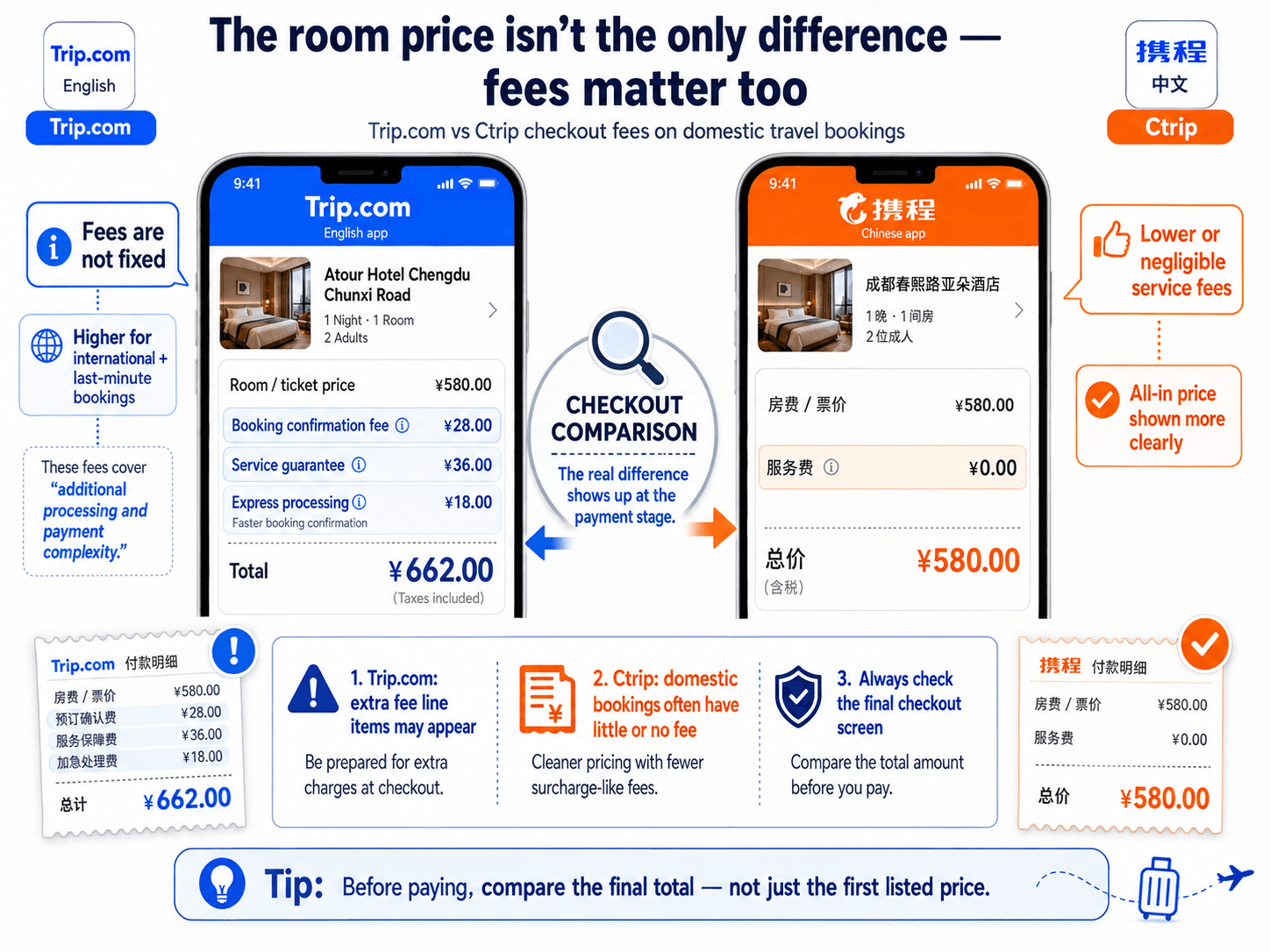
Verdict: Ctrip. The fee structure is leaner and more predictable.
Payment Processing: The Real Wall
This is where the comparison gets personal for expats. Trip.com accepts Visa, Mastercard, and PayPal, which makes it frictionless if you’re still using foreign cards. Ctrip requires Alipay, WeChat Pay, or a Chinese bank card for most transactions.
If you’ve already set up Alipay for international visitors, the payment wall on Ctrip drops significantly. Alipay now allows foreign passport holders to link international cards, though transaction limits and occasional verification hiccups remain. WeChat Pay offers similar functionality.
The payment processing cost difference is real. Cross-border credit card transactions involve interchange fees, currency conversion margins, and fraud screening that domestic Alipay payments simply don’t. Trip.com absorbs some of this and passes the rest to you.
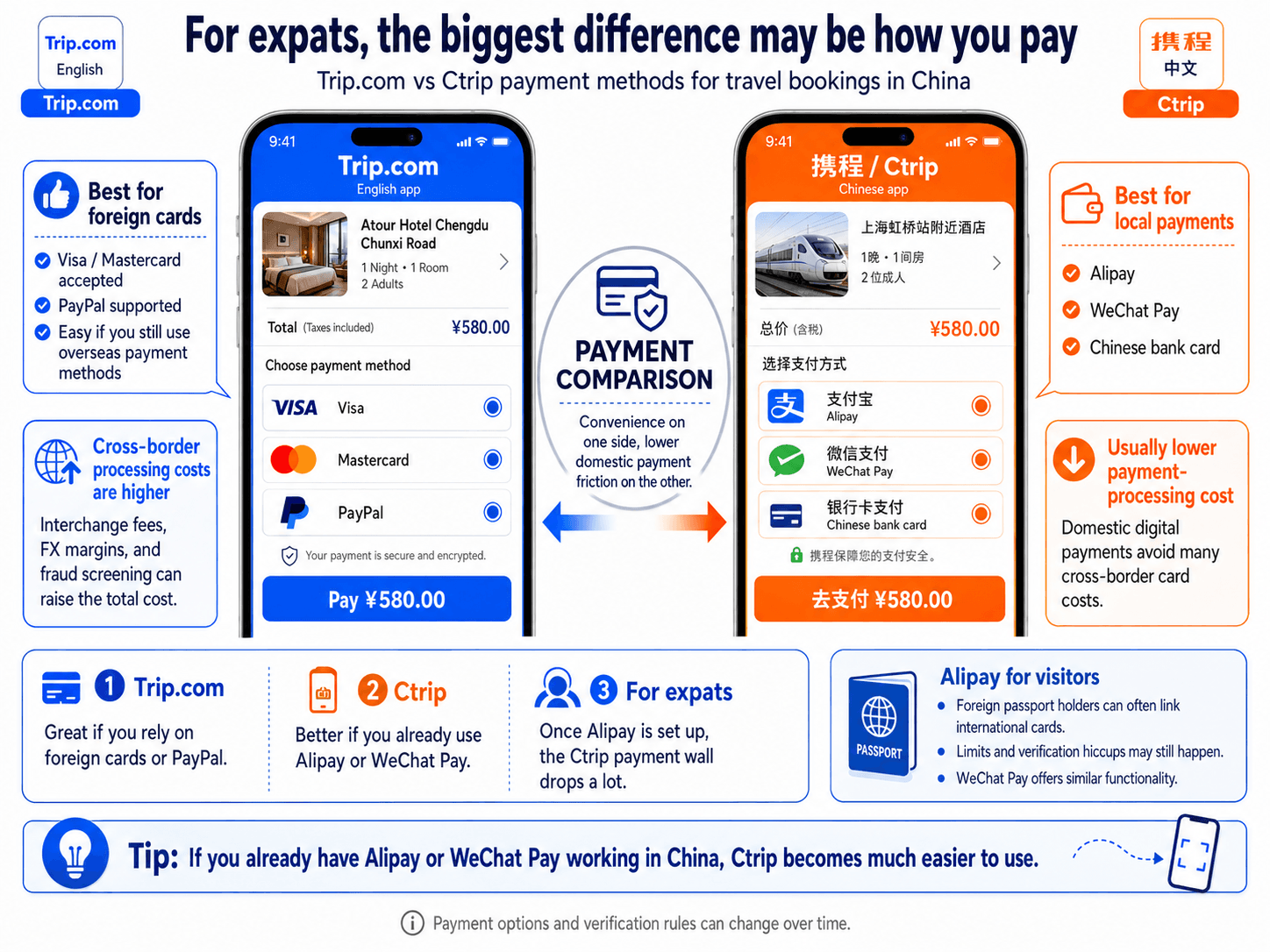
Verdict: Trip.com wins on ease. Ctrip wins on cost. If your Alipay works reliably, use Ctrip.
Add-On Defaults and Ancillary Services in Air Travel
Both platforms bundle extras into the booking flow, but Trip.com’s English interface tends to be more aggressive about it. Pre-checked travel insurance, “cancellation protection,” priority boarding, and airport lounge access can add $10–30 to a flight booking if you don’t actively uncheck them.
Ctrip does this too, but the domestic interface typically presents fewer pre-selected add-ons. Chinese consumer forums are vocal about this practice, and regulatory pressure has pushed Ctrip to reduce default bundling on the domestic side. The English-facing product hasn’t received the same scrutiny.
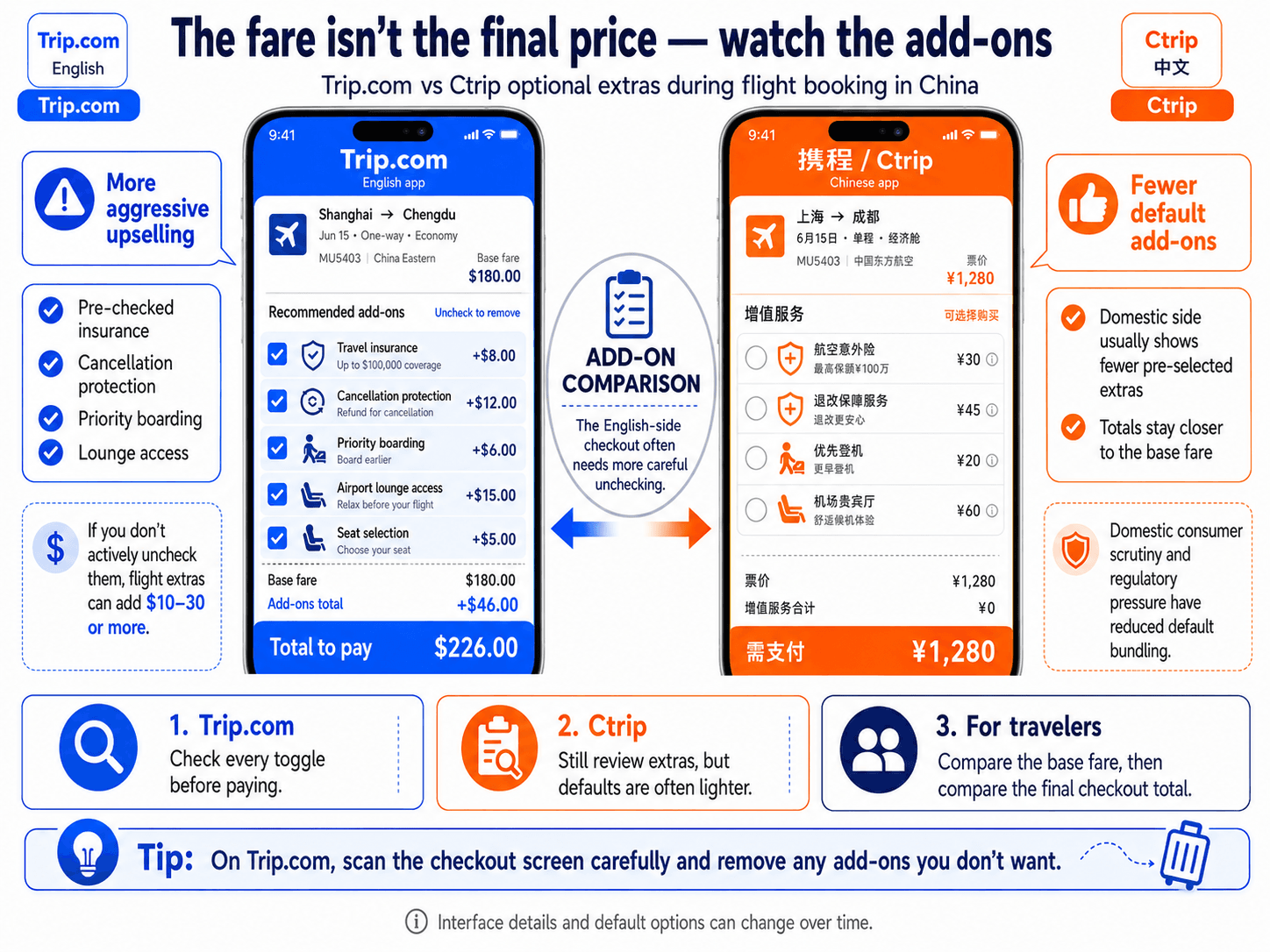
For ancillary services in air travel like seat selection, baggage, and meals, both platforms pull from the same airline inventory system. The price of these extras is usually identical. The difference is in the platform-level add-ons that sit on top.
Verdict: Ctrip, but only if you’re paying attention on both sides. Always review the checkout summary line by line.
Domestic Promotions and Coupons
Ctrip runs frequent domestic promotions: flash sales during holidays, loyalty point multipliers, new-user coupons, and destination-specific discounts. These are surfaced prominently in the Chinese app and are almost never available on Trip.com’s English interface.
Some of these promotions are genuinely significant. Discounts of ¥50–200 on hotel bookings or bundled train-plus-hotel packages at 15–20% off are common during off-peak periods. If you’re booking high-speed trains in China alongside hotels, Ctrip’s bundled deals can compound savings.
Trip.com occasionally runs international promotions, but these tend to target inbound tourists rather than residents. The coupon ecosystem is thinner and less rewarding for repeat domestic bookings.
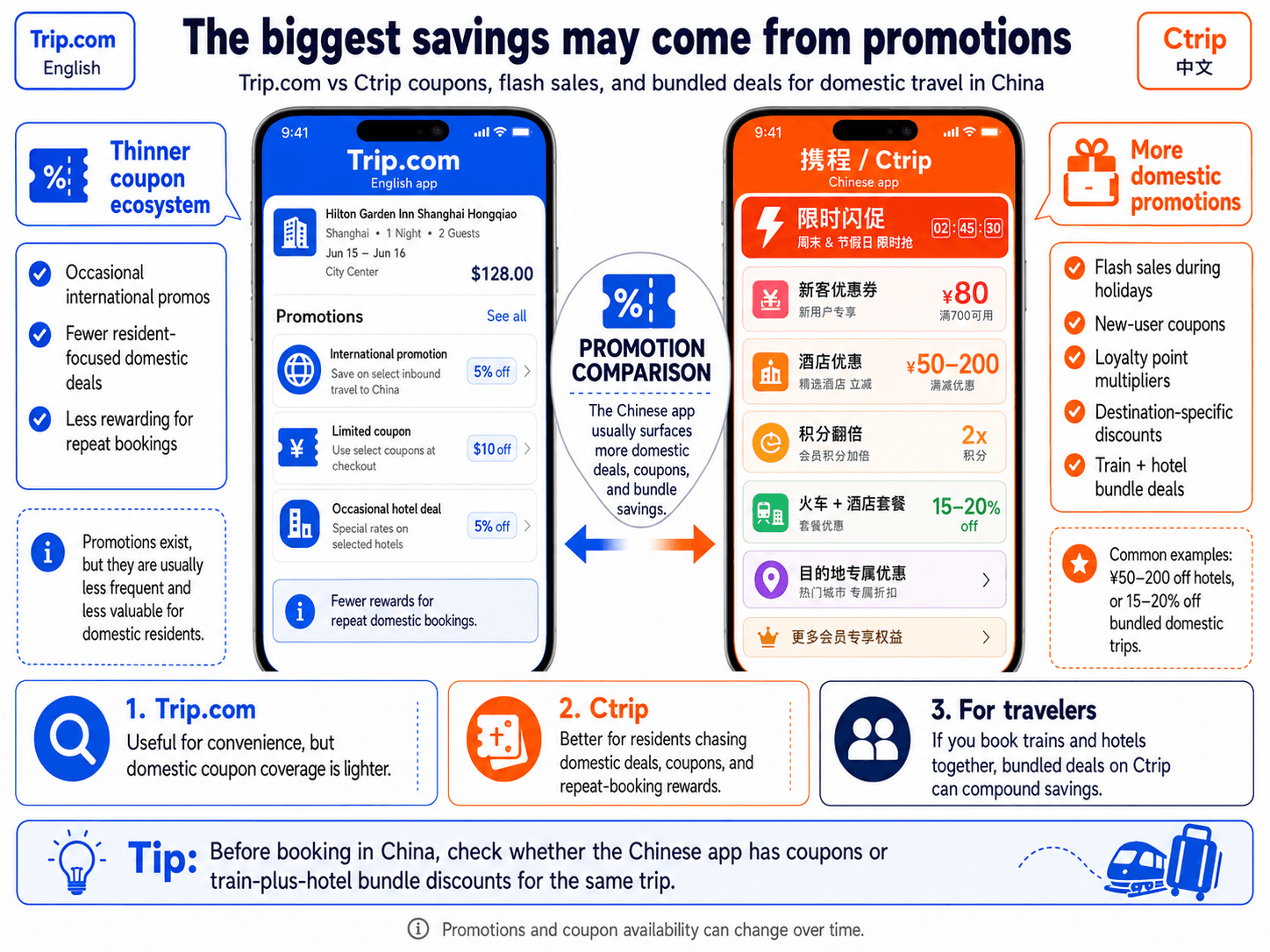
Verdict: Ctrip, decisively. The promotional gap is one of the biggest underappreciated cost differences.
Interface, Language, and Customer Support
Trip.com’s English interface is polished and intuitive. Search, filter, book, done. Customer support is available 24/7 in English via chat and phone. If something goes wrong with a booking, you can resolve it without speaking Mandarin.
Ctrip’s app is Mandarin-only. The layout is dense, with more information crammed onto each screen (a common Chinese app design pattern). Navigation is learnable but not intuitive for non-readers. Customer support is Mandarin-only, which can be a serious problem during cancellations, refund disputes, or last-minute changes.
For expats with intermediate Mandarin or a good translation app, Ctrip is manageable for straightforward bookings. For anything involving customer service interaction (flight cancellations, refund requests, name corrections on tickets), Trip.com’s English support is worth the premium.
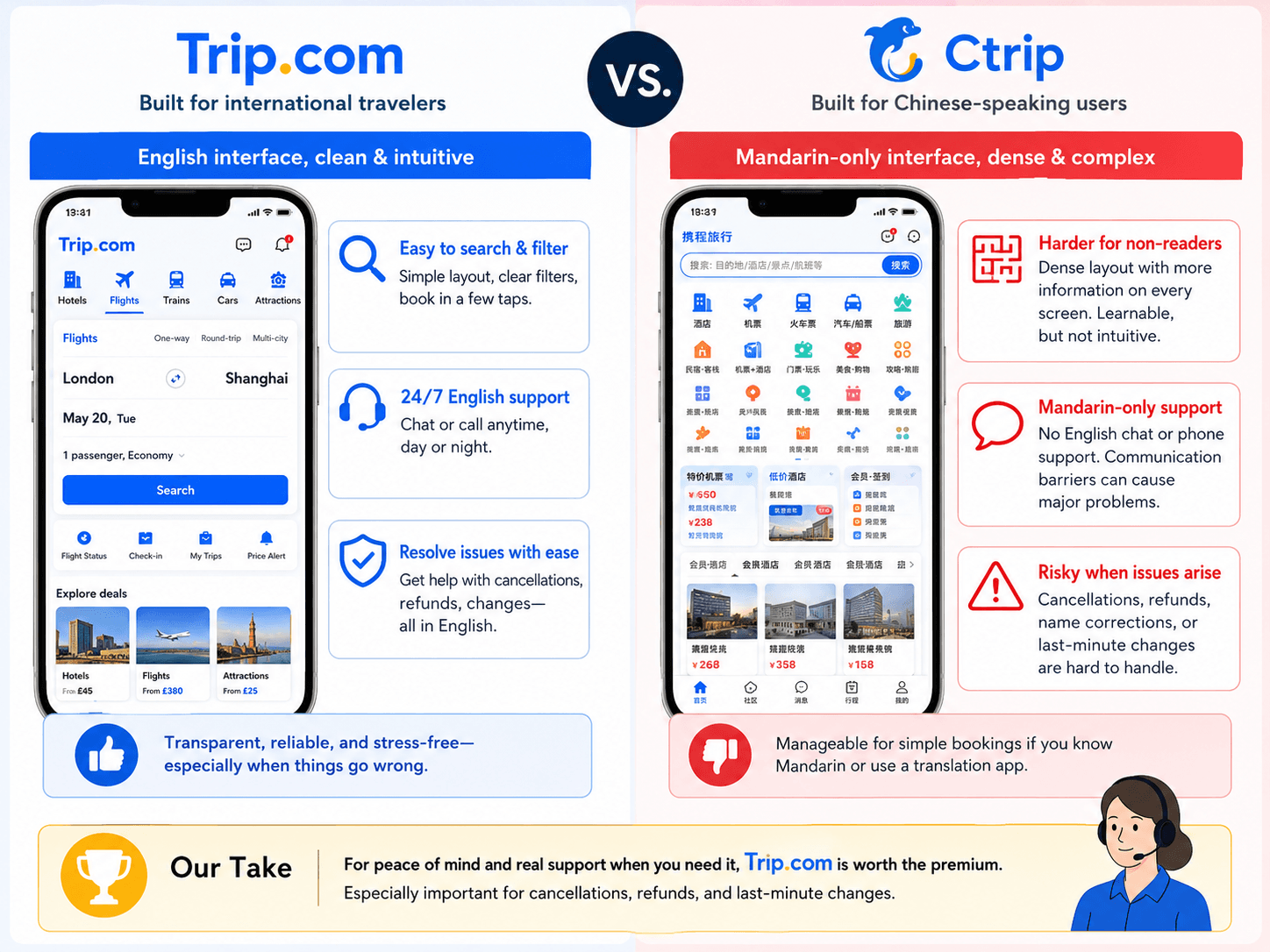
Verdict: Trip.com, clearly. When things go wrong, language matters.
Use Case Mapping: Which App for Which Situation
- Booking a budget hotel in a second-tier city (Chengdu, Kunming, Xi’an): Use Ctrip. The savings of 10–30% on domestic properties add up fast, and the booking flow for hotels is simple enough to navigate with a translation app.
- Booking a domestic flight for a weekend trip: Use Ctrip if your Alipay works. Prices can run 5–10% lower on the Chinese side for the same seat, and flight search engines on both apps pull from the same inventory.
- Booking an international flight with connections: Use Trip.com. Complex itineraries with multiple carriers benefit from English-language support and clearer fare rules. The markup is modest on international routes.
- Dealing with a cancellation or schedule change: Use Trip.com. Resolving disputes in Mandarin over Ctrip’s customer service line is painful even for fluent speakers. English support saves hours.
- Booking trains: Consider using China’s official 12306 app directly (it now has limited English support) or Ctrip for the Chinese-language bundle deals. For a walkthrough of the train system itself, this guide covers the full process.
What Both Platforms Get Wrong
Neither Trip.com nor Ctrip handles foreign passport names gracefully. Chinese ID cards have standardized formats; passports don’t. Name truncation, middle name fields, and character limits cause booking errors on both platforms, especially for train tickets where the name must match your travel document exactly.
Both platforms also struggle with transparent pricing. Even Ctrip, despite being cleaner, still buries some fees in the checkout flow. Neither platform provides a clear, upfront breakdown of base fare vs. taxes vs. service fees vs. add-ons before you reach the payment screen. This is an industry-wide problem across travel booking platforms, not unique to these two.
Migration and Switching Between Trip.com and Ctrip
The good news: switching between Trip.com and Ctrip is low-cost. They share the same parent company (Trip.com Group), and in some cases, your account credentials work across both platforms. Loyalty points earned on Trip.com can sometimes be used on Ctrip, though the integration is inconsistent.
The real switching cost is setup time. Getting Ctrip functional as a foreigner means ensuring your Alipay is working, your passport is verified in the app, and you can navigate the booking flow. Budget an hour for initial setup. After that, switching between apps per booking takes seconds.
There’s no meaningful lock-in. Hotel and flight bookings are standalone transactions. You won’t lose data or history that matters. The practical approach for most expats is to keep both apps installed and choose per booking based on the criteria above. For broader guidance on getting your digital toolkit set up, ChinaTravelMag’s essential apps guide walks through the full process.
Final Recommendation
The price difference between Trip.com and Ctrip is not a scam or a “foreigner tax” in the conspiratorial sense. It’s the accumulated cost of currency conversion, payment processing, English-language support infrastructure, and a promotional ecosystem that favors domestic users. Those costs are real, and Trip.com isn’t hiding them (they just aren’t highlighting them either).
If you’re an expat with working Alipay and basic Mandarin navigation skills, default to Ctrip for domestic bookings. You’ll save 5–30% depending on the property tier. Switch to Trip.com for international bookings, complex itineraries, or any situation where you might need to call customer support. Keep both apps on your phone. Use them like tools, not loyalties.
Frequently Asked Questions
Sources
- https://ca.trip.com/ask/questions/trip.com-booking-fee.html
- https://travelchinawith.me/china-facts/trip-com-vs-ctrip/
- https://chinatravelmag.com/the-essential-apps-that-replace-your-credit-cards-google-maps-and-english-menus-before-you-leave-the-hotel/
- https://www.trip.com
- https://chinatravelmag.com/a-foreigners-guide-to-taking-high-speed-trains-in-china/
- https://www.realchinaguide.com/trip-com-vs-ctrip-foreigners