A guide to decoding audience behavior at Chinese cultural performances so you participate, not just spectate
Learn the unwritten behavioral codes that shape how Chinese audiences engage with live performance. This guide covers teahouse opera, square dancing, temple festivals, and more — teaching you to read social cues and shift from passive tourist to welcomed participant.
TL;DR
- The audience is part of the performance — Chinese cultural events, especially community-facing ones, expect active audience participation. Silence and stillness can mark you as disconnected, not respectful.
- Match the room’s median behavior — Watch the audience before watching the stage. Mirror what the middle-of-the-road locals are doing: their noise level, phone usage, movement, and response patterns.
- Different performance types have different rules — A teahouse opera, a park square dance, and a temple festival each have distinct audience expectations. Calibrate to the specific event, not to a generic idea of “Chinese performance.”
- Accept social invitations when they come — When a local offers you tea, gestures to a seat, or includes you in conversation, say yes. These micro-interactions are the experience you came for.
- Manage your phone like a local — Quick photos are fine. Sustained recording, flash photography, and holding your phone above your head are the fastest ways to signal “tourist” and create distance between you and the room.
Guide Orientation: What This Covers and Who It’s For
This guide is about one specific skill: reading and responding to audience behavior at Chinese cultural performances. It covers teahouse opera, outdoor square dancing (广场舞), temple festivals, acrobatics shows, immersive dining theater, and neighborhood concert gatherings. It does not cover venue selection, ticketing logistics, or itinerary planning.
If you’re a foreign traveler (or planning to be one) who has sat through a Chinese performance feeling like you were watching from behind glass while everyone around you seemed plugged into something invisible, this is for you. The guide is built for informed adults who want to participate, not just spectate.
By the end, you’ll understand the unwritten behavioral codes that shape how Chinese audiences engage with live performance, how to recognize the social cues that signal when to respond, and how to shift from passive tourist to welcomed participant without overstepping. You’ll also know the common mistakes that mark someone as oblivious rather than simply foreign.
Why Reading the Room at Non-Touristy Attractions Matters
The difference between a performance that feels like a museum exhibit and one that genuinely pulls you in is almost never about the show. It’s about knowing how the local audience participates in it. Chinese cultural performances, especially those outside the tourist circuit, are rarely designed for silent, seated observation. They’re communal events with their own grammar of participation: when to clap, when to shout approval, when to pour tea for the person beside you, when to stay absolutely still.
Foreign visitors routinely miss this layer. The result isn’t just a diminished experience for the traveler. It can create real social friction. Clapping at the wrong moment during a Sichuan opera face-changing act can disrupt the performer’s timing. Standing to photograph a temple ceremony can block sightlines that locals have carefully negotiated. Recording a neighborhood erhu player without acknowledgment can feel extractive rather than appreciative.
The cost of getting this wrong isn’t dramatic. Nobody will confront you. But you’ll remain on the outside of something designed to be shared. And in a country where consumer demand is shifting hard toward local immersion over mainstream sightseeing , the travelers who understand communal performance norms are the ones who actually get what they came for. The show is only half the experience. The other half is the room.
Core Concepts: The Grammar of Chinese Audience Participation
Performance as Social Event, Not Spectacle
In much of the Western performing arts tradition, the audience’s job is to be quiet, attentive, and reactive only at designated moments (applause between movements, laughter at punchlines). Chinese performance culture, particularly in traditional and community-driven forms, operates on a different assumption: the audience is part of the event’s energy. Teahouse opera audiences talk, eat, and call out to performers. Square dance participants drift in and out. Temple festival crowds treat performance as ambient, weaving worship and socializing around it.
This doesn’t mean anything goes. It means the rules are different, and they’re calibrated to context rather than enforced by ushers.
The Distinction Between Tourist-Facing and Community-Facing Events
Tourist-facing performances (large-scale acrobatics in Beijing, the Impression series by Zhang Yimou) are structured for passive consumption. They have fixed seating, clear start/end times, and expect Western-style audience behavior. Community-facing performances (a Cantonese opera in a Guangzhou park, a storytelling session in a Chengdu teahouse) assume shared cultural knowledge. The gap between these two types is where most foreign visitors get lost.
The Concept of 热闹 (Rènao)
This term, often translated as “lively” or “bustling,” is central to understanding Chinese audience behavior. A good performance isn’t just skilled; it’s 热闹. The audience’s noise, movement, and visible enjoyment are not distractions from the performance. They are evidence that the performance is working. When you see a crowd being loud at a show, they’re not being rude. They’re fulfilling their role.
Face and the Foreign Guest
Chinese social dynamics around 面子 (face) work in your favor here. As a visible foreigner making an effort to participate appropriately, you’ll almost always be met with warmth and accommodation. The threshold for “getting it right” is lower for you than for a local. But the threshold for “being disruptive” is also lower, because your behavior is more visible.
The Framework: Four Phases of Reading the Room
The method for navigating any Chinese cultural performance as a foreign visitor follows four phases. These aren’t sequential steps you complete once. They’re a cycle you repeat throughout the event, adjusting as the room’s energy shifts.
- Phase 1: Observe Before Entering — Assess the event type, audience composition, and energy level from the periphery before committing to a position.
- Phase 2: Mirror the Median — Match the behavior of the middle-of-the-road audience members, not the most enthusiastic and not the most reserved.
- Phase 3: Respond to Social Invitations — Recognize when locals are opening a door for you to participate more actively, and step through it.
- Phase 4: Contribute Without Centering Yourself — Add to the communal energy without making your participation the story.
These phases apply whether you’re at a Kunqu opera in Suzhou, a fire-breathing act at a Lantern Festival, or an immersive dining theater experience in Chongqing . The specifics change; the cycle doesn’t.
Step-by-Step Breakdown: How to Read and Respond to Chinese Performance Audiences
Step 1: Arrive Early and Read the Space from the Edge
Objective: Understand the event’s social structure before you’re inside it.
Get to the venue (or outdoor space) 10 to 15 minutes before the performance begins, or before you plan to engage. Don’t walk straight to the front or center. Position yourself at the periphery and watch. What you’re looking for: How are people arranged? Are there clear rows, or is the crowd loose and mobile? Are people eating and drinking? Are children running around? Is there a designated performer space, or does the boundary between audience and performer seem porous?
At a Chengdu teahouse opera, for example, you’ll notice regulars have claimed specific tables. Tea is already poured. Conversations are happening at full volume. This tells you the event is social-first, performance-second. At a temple festival stage, you might see families with blankets and snacks spread out at varying distances. This tells you proximity to the stage is a choice, not an assignment.
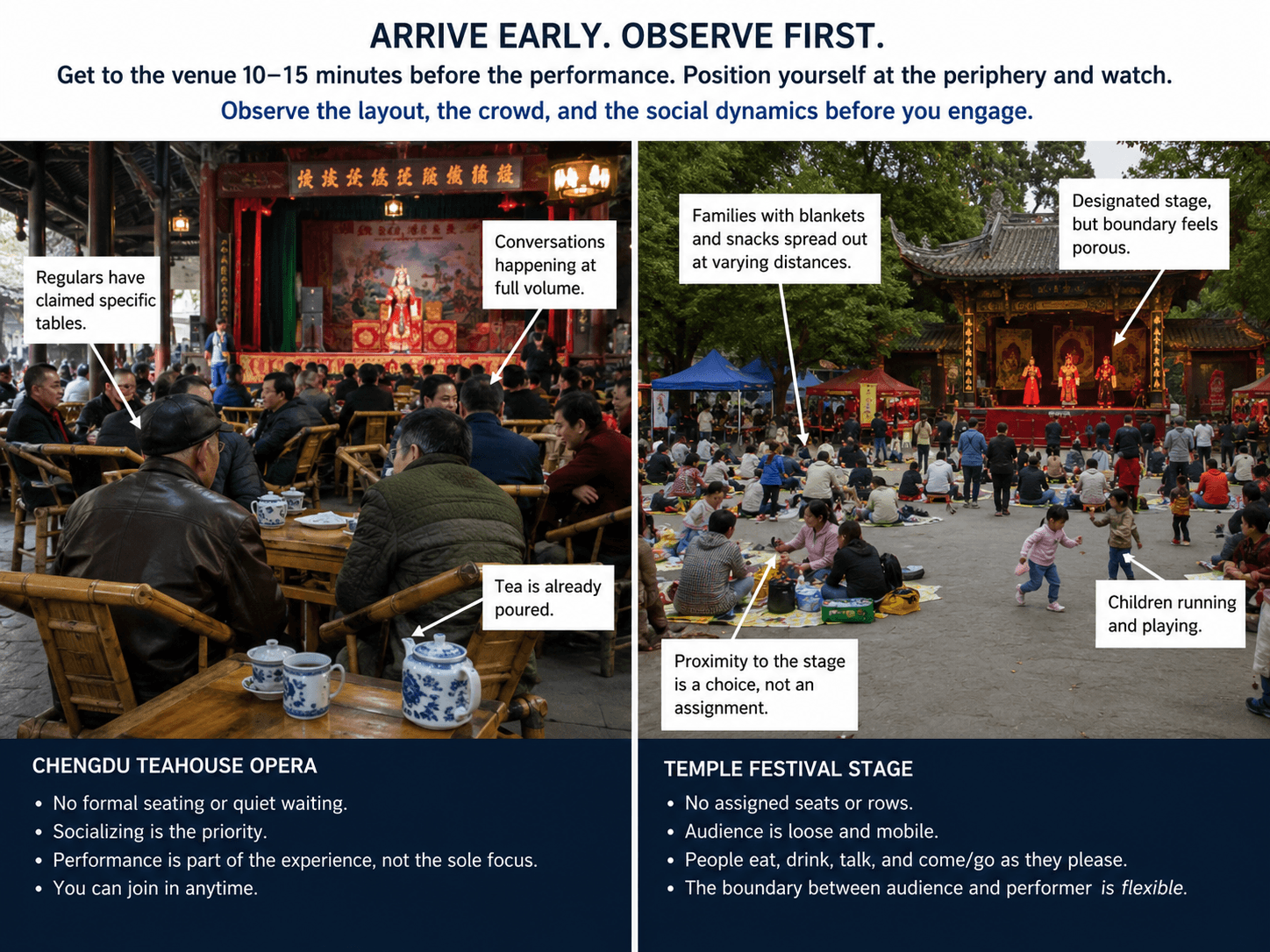
Anti-patterns: Walking directly to the front row. Pulling out your phone immediately. Asking loudly (in English) where you should sit. Treating the space like a theater with invisible assigned seating.
Success indicators: You’ve identified the general energy level (quiet and focused vs. loose and social). You’ve noticed where regulars are sitting. You’ve chosen a position that gives you good sightlines without displacing anyone.
Step 2: Calibrate Your Behavior to the Room’s Median
Objective: Blend into the audience’s behavioral range rather than standing out at either extreme.
Once you’re settled, spend the first five to ten minutes doing nothing but watching the audience, not the stage. Identify the behavioral median. In a teahouse, this might mean light conversation, occasional laughter, and sipping tea during the performance. At a park opera gathering, it might mean humming along quietly, nodding, or tapping a hand on a knee. At a formal Kunqu performance in a heritage theater, it might mean near-silence with sharp, brief exclamations of approval (“好!” / “Hǎo!”) at virtuosic moments.
Your goal is to match this median, not to perform enthusiasm you don’t feel and not to sit in rigid silence when everyone around you is chatting. The median is your safe zone. It signals that you understand the room without requiring you to know every specific convention.
This is where understanding Chinese social etiquette norms becomes genuinely useful. The same instinct that governs who pours tea first at a dinner table governs who speaks and when at a communal performance. Hierarchy, reciprocity, and attentiveness to others’ comfort are always in play.
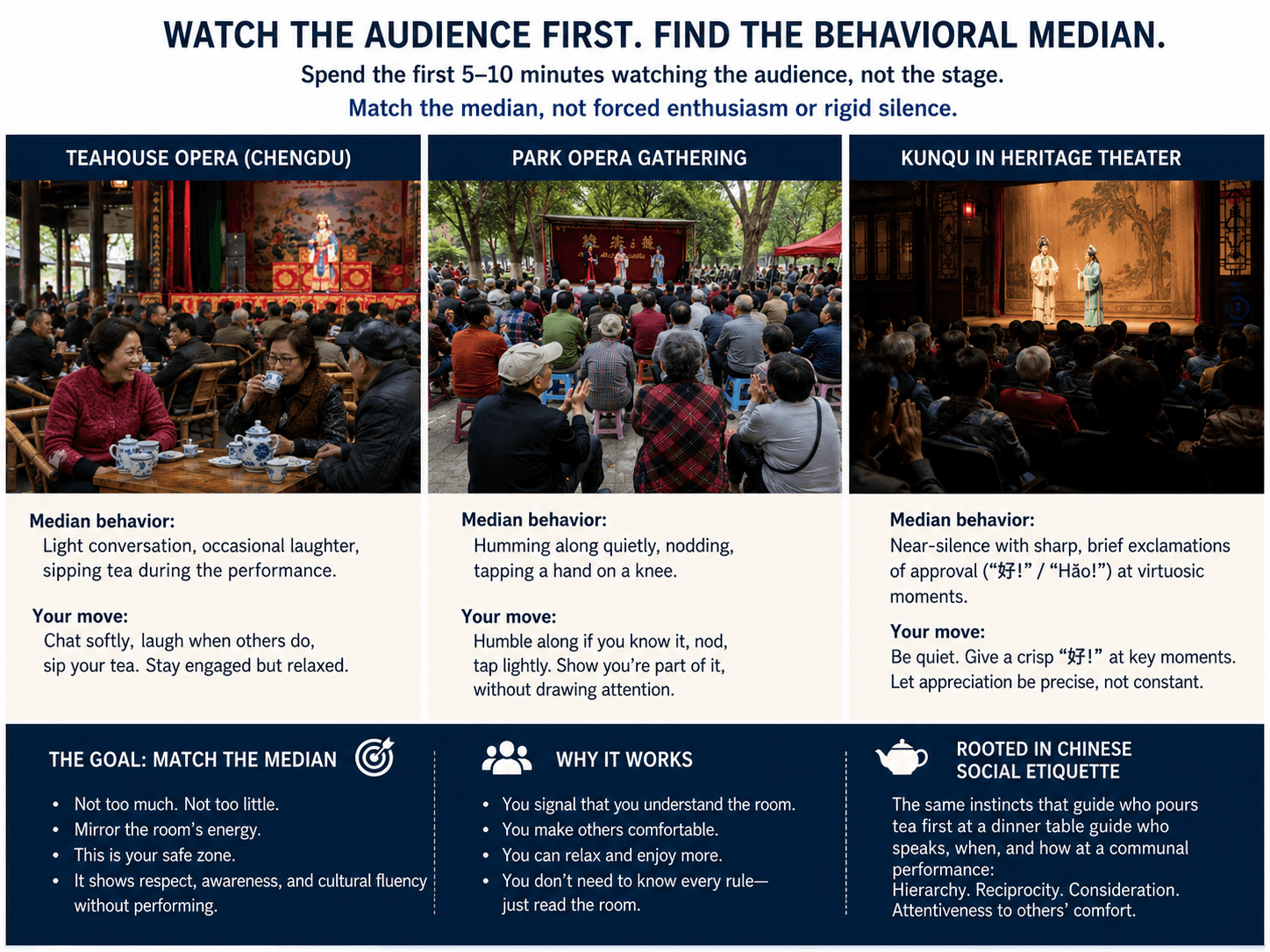
Anti-patterns: Being the loudest person in the room. Being the quietest person in a loud room. Clapping after every segment when no one else is. Sitting with arms crossed and a neutral expression at a 热闹 event.
Success indicators: If someone glanced at you, they’d assume you’d been here before. Your body language and noise level are indistinguishable from the people around you.
Step 3: Decode the Audience’s Response Vocabulary
Objective: Learn the specific signals this audience uses to interact with performers, so you can deploy them accurately.
Every performance type has its own audience response vocabulary. This is the part that no generic travel guide covers, and it’s the part that makes the biggest difference. Here are the most common patterns you’ll encounter:
- Teahouse opera / Sichuan opera: Shouts of “好!” (Hǎo!, meaning “Good!” or “Bravo!”) at the end of a skilled vocal passage or acrobatic move. Timing matters. The shout comes at the resolution of a phrase, not during it. Listen for locals doing it first, then join on the next one.
- Square dancing (广场舞): No formal audience. If you’re watching, you’re on the fringe of a participation event. The “response” is joining in, even clumsily. Smiling and attempting the moves is the expected behavior. Standing and filming is tolerated but marks you as an outsider.
- Temple festivals: Applause is less common. Respectful attention, placing incense, or making small offerings are the participation modes. Silence during ritual segments is important. Socializing resumes between acts.
- Immersive dining theater: These newer formats (popular in cities like Chongqing and Xi’an) often have hosts who explicitly coach audience participation. Follow their lead. The audience around you will be playing along enthusiastically. Your job is to match their energy.
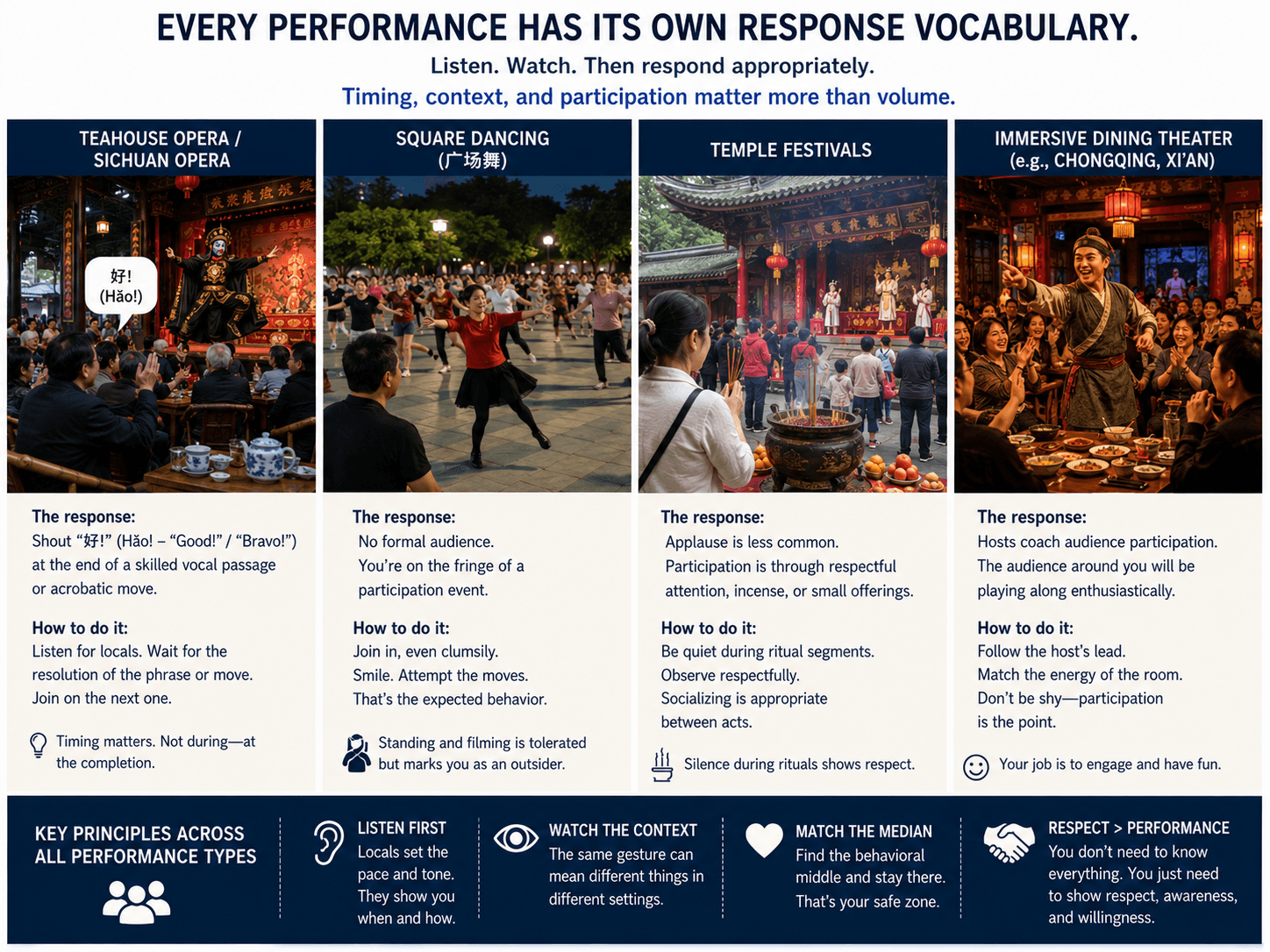
Anti-patterns: Shouting “好!” at random moments. Applauding during a ritual segment at a temple. Filming a square dance group from ten feet away without engaging. Treating every performance type identically.
Success indicators: You can identify at least two or three specific audience behaviors unique to this event and deploy them at roughly the right moments. A local near you nods, smiles, or gives you a thumbs-up.
Step 4: Recognize and Accept Social Invitations
Objective: Shift from observer to participant when locals open the door.
This is the moment that separates community-driven travel from tourism. At some point during many community-facing performances, a local will make an overture. It might be subtle: offering you sunflower seeds, gesturing to an empty chair closer to the action, pouring you tea, or asking (often through gestures or basic English) where you’re from. This is an invitation to move from the periphery toward the center of the social event.
Accept it. Say “谢谢” (xièxie, thank you). Sit down. Take the seeds. Pour tea back for them. These micro-interactions are the actual experience. The performance on stage is the shared context that makes them possible, not the other way around.
In more structured settings, the invitation might come from a performer. At some teahouse shows, performers will single out a foreign guest for a brief, friendly interaction. This is not mockery. It’s inclusion. Smile, play along, and don’t retreat into your phone. ChinaTravelMag regularly documents these kinds of moments in its experience guides, and their coverage of specific venues can help you anticipate what to expect before you arrive.
Anti-patterns: Declining every social overture out of shyness or suspicion. Over-reciprocating (buying rounds of drinks for strangers at a teahouse, for instance, which can create an awkward obligation dynamic). Treating a performer’s interaction as a photo opportunity rather than a human exchange.
Success indicators: You’ve had at least one genuine, unscripted interaction with a local audience member. You feel less like a spectator and more like a guest.
Step 5: Manage Your Technology Thoughtfully
Objective: Document the experience without letting your device become a barrier between you and the room.
This step deserves its own section because phone and camera behavior is the single fastest way to signal “tourist” in a Chinese performance context. The issue isn’t that locals don’t use their phones. They do, constantly. The issue is how and when.
Local audience members typically take a few quick photos or short video clips and then put the phone away. They might share something to WeChat Moments in real time, but the phone is a tool for brief capture, not sustained recording. A foreign visitor holding up a phone for a continuous five-minute video, especially with flash, is immediately conspicuous and often unwelcome.
The rule of thumb: match the local phone behavior. If people around you are taking photos, take a few. If nobody has a phone out (common during ritual or sacred segments at temple performances), put yours away completely. If you want to capture something longer, ask a nearby local with a gesture and a smile. Most will be happy to help, and some will insist on taking your photo for you.
At outdoor community events like square dancing or park opera, photography is generally more relaxed. But even here, the distinction between “capturing a moment” and “documenting the locals” matters. People can feel the difference.
Anti-patterns: Recording entire performances. Using flash in dim teahouses. Holding your phone above your head and blocking sightlines. Taking close-up photos of performers or audience members without any acknowledgment.
Success indicators: Your phone has been in your pocket for most of the event. You have a few good photos. Nobody has visibly reacted to your filming.
Step 6: Know When and How to Leave
Objective: Exit gracefully, preserving the goodwill you’ve built.
Community-facing Chinese performances often don’t have a clean ending. Teahouse opera runs in cycles. Square dancing goes until the group decides to stop. Temple festival performances repeat throughout the day. This means you’ll likely need to leave before the event “ends,” and how you do it matters.
The key principle: leave during a natural break, not during a performance peak. Between songs, between acts, during a tea refill pause. If you’ve been sitting with locals, a simple nod, smile, and “谢谢” is sufficient. Don’t make a production of your departure. If someone has been particularly welcoming, a brief handshake or a slight bow of the head (not a deep bow, which reads as performative) communicates genuine gratitude.
At more formal seated performances, wait for an intermission or a clear act break. Leaving mid-performance in a small venue is more disruptive than in a large one, because your movement is more visible. If you’re at a packed itinerary stop in a city like Chongqing , plan your timing so you’re not rushing out of a teahouse mid-aria to catch a train.
Anti-patterns: Standing up and walking out during a climactic moment. Saying loud goodbyes that draw attention. Lingering awkwardly after you’ve clearly disengaged. Leaving without acknowledging anyone who hosted or welcomed you.
Success indicators: Nobody noticed you leave, or the people near you exchanged a warm goodbye. You feel like you could come back tomorrow and be recognized.
Practical Examples: Three Scenarios Compared
Scenario A: Sichuan Opera Face-Changing in a Tourist Venue vs. a Local Teahouse
In a tourist-oriented Sichuan opera show (common in Chengdu’s Jinli Street area), the audience is mostly visitors. The emcee explains acts in Mandarin and sometimes English. Applause is expected after each segment. Phones are everywhere. The behavioral expectation is essentially Western theater with Chinese content.
In a neighborhood teahouse hosting the same face-changing performer, the dynamic is completely different. Regulars shout “好!” at precise moments. Tea flows continuously. The performer may interact with specific audience members between masks. A foreign visitor who sits quietly, watches the regulars, and eventually lets out a well-timed “好!” will earn genuine smiles. One who films the entire act on a selfie stick will be politely ignored.
Scenario B: Morning Park Opera in Guangzhou
In Liwan Park or Yuexiu Park, retired Cantonese opera enthusiasts gather most mornings to sing, accompanied by a small traditional orchestra. There is no stage, no ticket, no start time. The “audience” is other enthusiasts, morning exercisers, and passersby. The correct behavior is to drift close, listen, and settle onto a bench if one is available. If someone offers you tea from a thermos, accept. If a singer finishes a piece and looks in your direction, a nod of appreciation is perfect. Attempting to join the singing (unless you actually know Cantonese opera) would be overstepping. Sitting and listening for twenty minutes, then moving on, is exactly right.
Scenario C: Lantern Festival Street Performance in a Small City
At a Lantern Festival celebration in a smaller city (not Beijing or Shanghai), street performances including lion dance, stilt walking, and firecrackers create a chaotic, joyful environment. The audience behavior here is pure 热闹. Children are on shoulders. Firecrackers go off at close range. People push forward to see and pull back when the lion dancers charge the crowd. The correct behavior is to be in the crowd, not adjacent to it. Laugh when people laugh. Flinch when the firecrackers pop. Buy tangyuan from a street vendor. This is not a performance you watch. It’s an event you’re inside.
Common Mistakes and Pitfalls
The most common mistake isn’t rudeness. It’s self-consciousness. Foreign visitors often hold back from participating because they’re afraid of doing something wrong, and that hesitation itself becomes the barrier. A slightly mistimed “好!” is infinitely better received than thirty minutes of rigid silence in a room full of energy.
The second most common mistake is treating every Chinese performance like the same category. A Kunqu opera and a square dance have about as much behavioral overlap as a symphony and a street busker. Calibrate to the specific event, not to “Chinese performance” as a monolith.
Other predictable pitfalls: assuming that community events are designed for your consumption (they’re not, you’re a guest), confusing volume with rudeness (热闹 is a feature, not a bug), and over-relying on smartphone tools when direct human observation would serve you better.
None of these mistakes are fatal. Chinese audiences are remarkably forgiving of foreign visitors who are clearly trying. The goal isn’t perfection. It’s presence.
What to Do Next
Start with one performance. Not the biggest, most famous one you can find, but the smallest, most local one you stumble across. A park gathering. A teahouse afternoon session. A neighborhood festival stage. Arrive early. Sit at the edge. Watch the audience before you watch the performers. Match the median. Accept the tea.
You won’t get everything right the first time, and that’s fine. The framework here (observe, mirror, respond, contribute) is designed to be repeated and refined across multiple experiences. Each time, you’ll read the room a little faster and a little more accurately.
If you want to go deeper, seek out local guides and hosts who can sit beside you at these events and translate not just the language but the social dynamics in real time. The gap between watching a performance and being part of one is smaller than you think. It just requires paying attention to the room as much as the stage.
Frequently Asked Questions
Sources
- https://wandering-everywhere.com/5-travel-companies-that-focus-on-authentic-non-touristy-trips/
- https://chinatravelmag.com/chongqing-liyan-baguo-huayan-banquet-etiquette-of-the-eight-kingdoms/
- https://chinatravelmag.com/chinese-dinner-etiquette-a-step-by-step-guide/
- https://www.chinatravelmag.com
- https://chinatravelmag.com/chongqing-one-day-itinerary-from-ancient-stilt-houses-to-a-train-inside-an-apartment/
- https://chinatravelmag.com/chinese-metro-guide-security-alipay-escalator-rules-local-tips/
- https://www.toursbylocals.com
- https://maps.google.com/localguides/