How to navigate temples, markets, and street scenes without creating friction you never see coming
Learn the unwritten photography etiquette rules that shape how people across China perceive your camera. This guide breaks down specific situations — from temple visits to street portraits — where Western defaults around consent and documentation read as disrespect.
TL;DR
- Don’t assume consent in China – Unlike many Western countries, Chinese law and culture default to the idea that your image belongs to you. Ask before photographing individuals, especially strangers, vendors, and children.
- Temples are worship spaces, not photo ops – Most temples prohibit photography inside main halls. Stick to courtyards and exteriors unless you see clear permission, and never photograph worshippers without asking.
- Context determines everything – People welcome you photographing your hotpot; they do not welcome you photographing the table next to you. A vendor who just sold you food may pose happily; a stranger on the subway will not.
- Government and military sites are off-limits – If a building has guards, barriers, or official signage, do not photograph it. If stopped, cooperate and delete without argument.
- Start with three habits – Ask before shooting people, default to no in temples and on transit, and put the camera away near anything official or sensitive. These cover 90% of situations.
Why Your Camera Creates Problems You Don’t See Coming
Photography etiquette in China operates on a different set of assumptions than most Western visitors carry. In much of North America and Europe, pointing a camera at a street scene, a market vendor, or an interesting stranger feels like a neutral act. In China, it is a social act, and a mix of legal protections, cultural values around “face” (面子), and a rapidly evolving public conversation about privacy shape those rules.
The friction is rarely dramatic. Nobody will tackle you for snapping a photo at a night market. But the discomfort you create is real, and it registers as disrespect rather than ignorance. 73% of travelers say they would feel better visiting a place if it preserved local culture. That preservation starts with how you behave, not just what you spend.
This guide treats photography as a series of social negotiations, not a checklist of banned locations. Each situation below carries its own logic.
Who This Is For and What It Covers
This is for Western visitors (primarily from North America and Europe) traveling in China for the first time or returning after a long gap. It assumes you carry a smartphone, maybe a mirrorless camera, and a genuine desire to respect local customs without being paralyzed by anxiety.
This is not a legal primer on China’s Civil Code. It is not a guide to professional photography permits. It covers the everyday situations where your instincts as a visitor will quietly diverge from local expectations, and what to do instead.
How These Situations Were Selected
We chose each item below because it represents a scenario where the Western default (shoot first, ask later, or assume public space equals consent) collides with Chinese norms. We prioritized situations that are common, that carry real social consequences, and where you can’t figure out the correct behavior just by watching.
8 Photography Situations Where Western Defaults Fail in China
1. Photographing Strangers on the Street
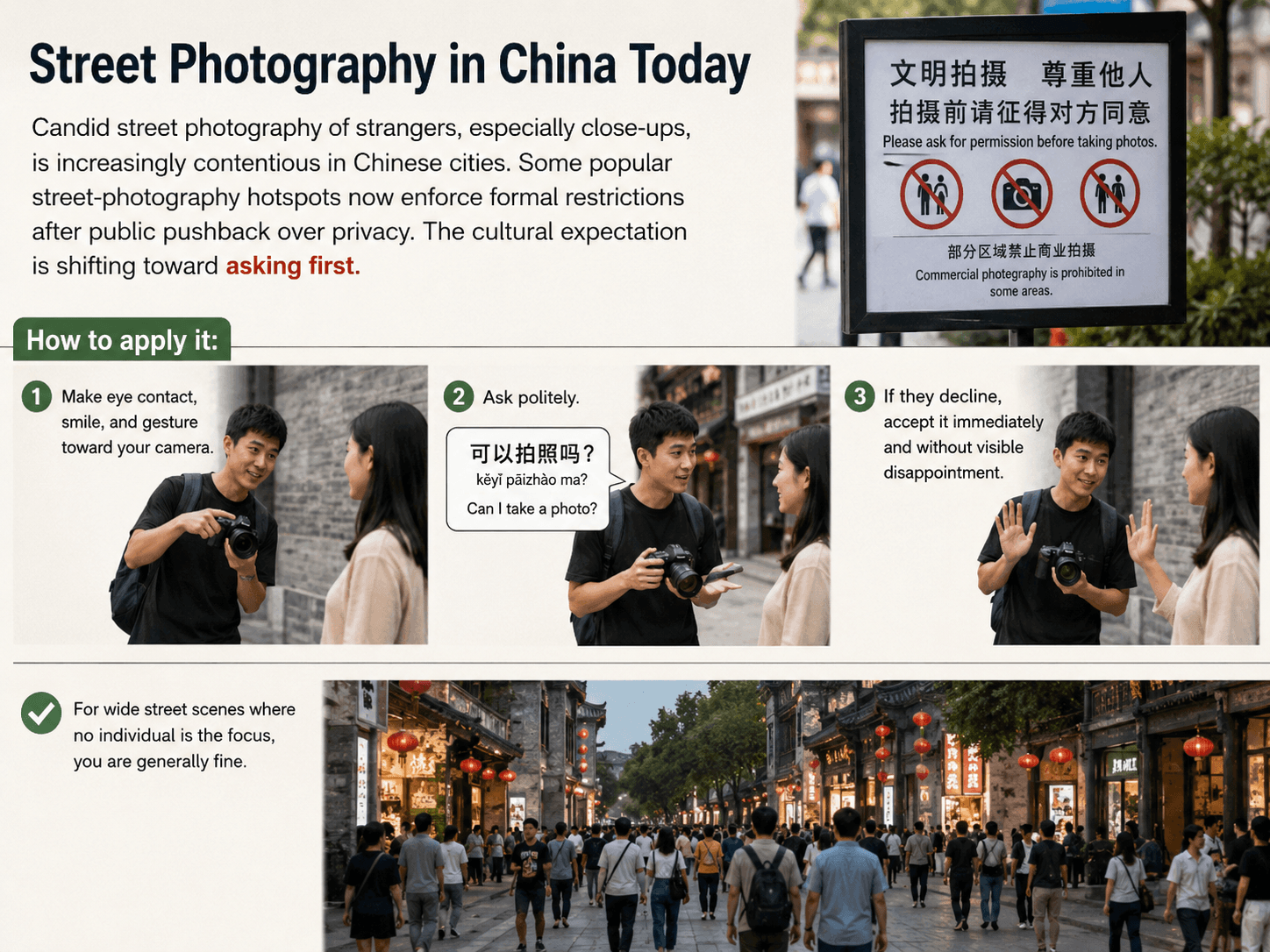
Why it matters: In many Western countries, street photography of people in public spaces is broadly legal and culturally tolerated. In China, things work differently. Under China’s Civil Code, individuals have explicit image rights. As Beijing-based lawyer Yi Yan noted in 2023 , people you photograph in public can demand you remove their images if you post them without consent.
What it looks like today: Candid street photography of strangers, especially close-ups, is increasingly contentious in Chinese cities. Some popular street-photography hotspots now enforce formal restrictions after public pushback over privacy. The cultural expectation is shifting toward asking first.
How to apply it: If you want to photograph someone, make eye contact, smile, and gesture toward your camera. A simple “可以拍照吗?” (kěyǐ pāizhào ma? / Can I take a photo?) goes a long way. If they decline, accept it immediately and without visible disappointment. For wide street scenes where no individual is the focus, you are generally fine.
2. Inside Buddhist and Taoist Temples
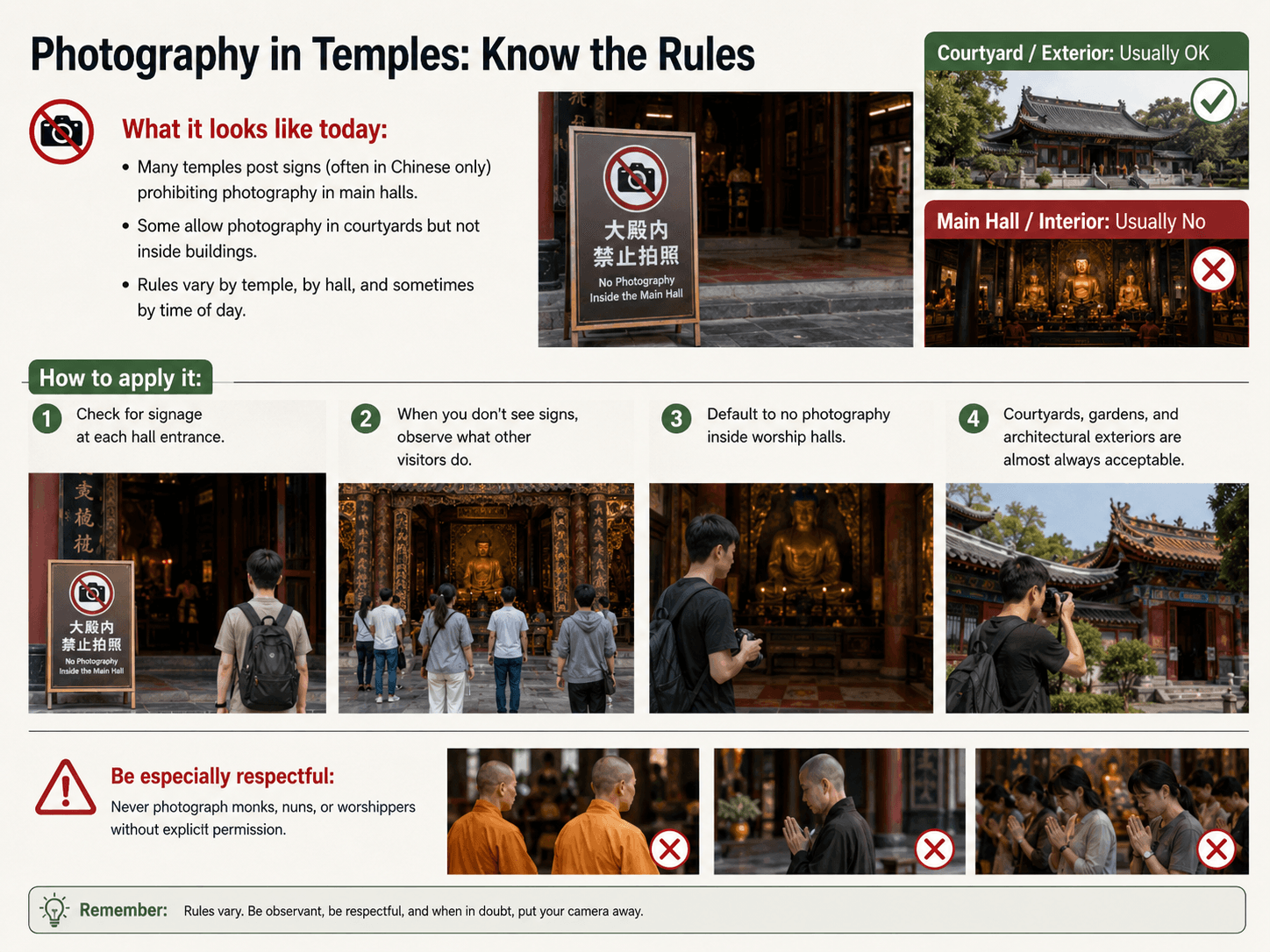
Why it matters: Temples in China are active places of worship, not museums. Photographing someone mid-prayer, or using flash near statues, tells people you view their spiritual practice as a spectacle. This directly affronts “face” and the sanctity of the space.
What it looks like today: Many temples post signs (often in Chinese only) prohibiting photography in main halls. Some allow photography in courtyards but not inside buildings. Rules vary by temple, by hall, and sometimes by time of day.
How to apply it: Check for signage at each hall entrance. When you don’t see signs, observe what other visitors do. Default to no photography inside worship halls. Courtyards, gardens, and architectural exteriors are almost always acceptable. Never photograph monks, nuns, or worshippers without explicit permission.
3. Markets, Street Food Vendors, and Small Shops
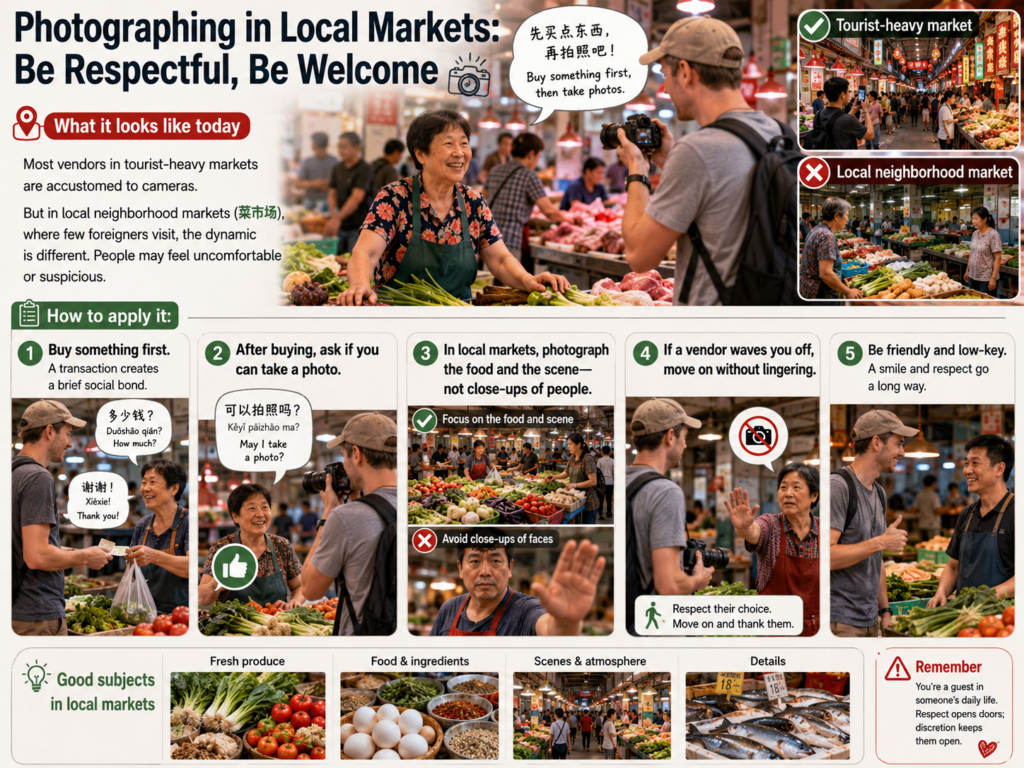
Why it matters: Western travel content often frames market photography as capturing “authentic local life.” From the vendor’s perspective, having a foreigner photograph them can feel like someone turning them into an exhibit. Some vendors also worry that unflattering photos posted online could hurt their business.
What it looks like today: Most vendors in tourist-heavy markets are accustomed to cameras. But in local neighborhood markets (菜市场), where few foreigners visit, the dynamic is different. People may feel uncomfortable or suspicious.
How to apply it: Buy something first. A transaction creates a brief social bond. After buying, ask if you can take a photo. In local markets, photograph the food and the scene rather than zooming in on people’s faces. If a vendor waves you off, move on without lingering.
4. Children
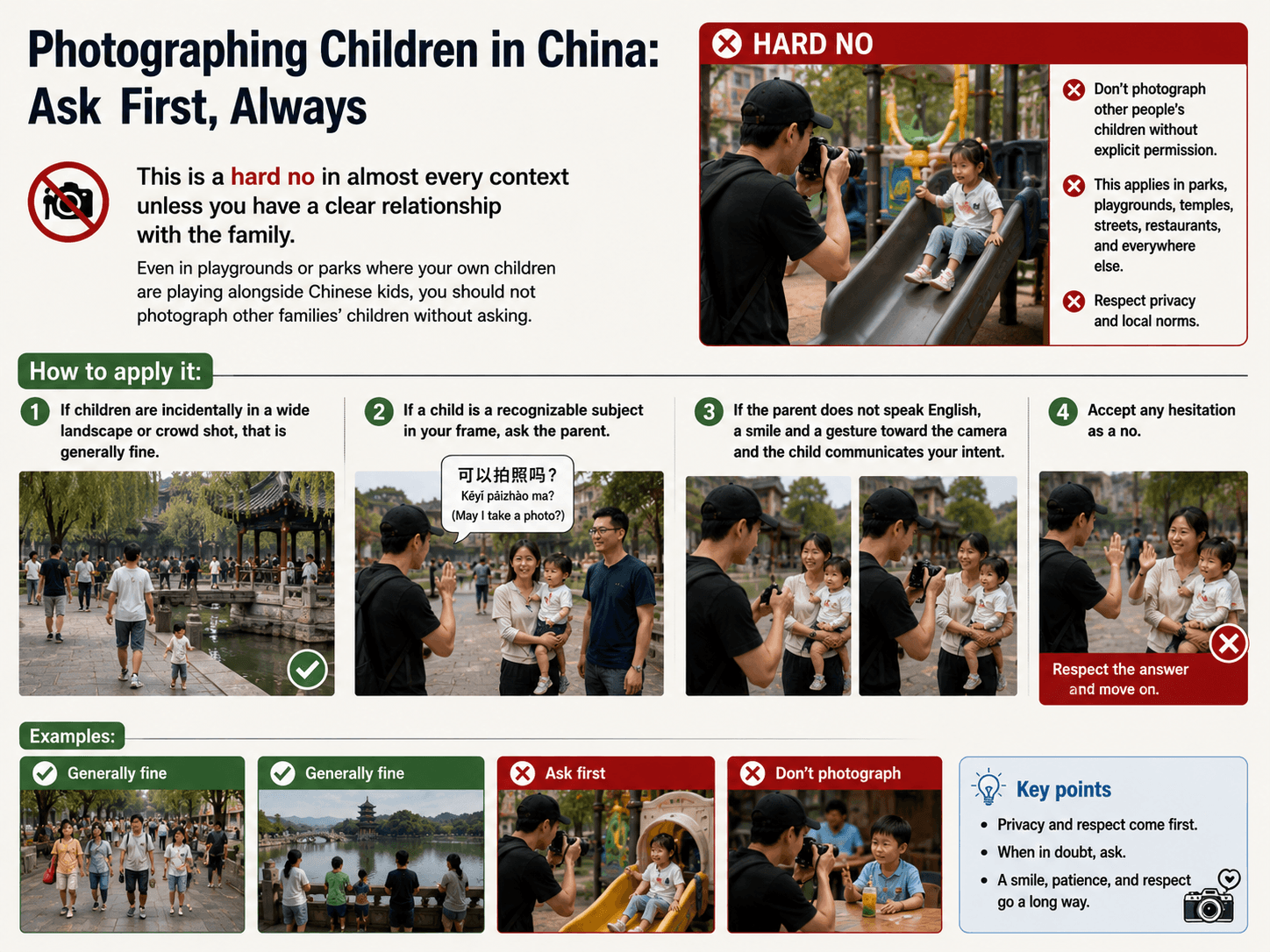
Why it matters: Photographing other people’s children without permission makes most people uncomfortable, regardless of culture. In China, the sensitivity runs even higher. Parents and grandparents are often highly protective, and a stranger (particularly a foreign stranger) pointing a camera at a child can trigger alarm.
What it looks like today: This is a hard no in almost every context unless you have a clear relationship with the family. Even in playgrounds or parks where your own children are playing alongside Chinese kids, you should not photograph other families’ children without asking.
How to apply it: If children are incidentally in a wide landscape or crowd shot, that is generally fine. If a child is a recognizable subject in your frame, ask the parent. If the parent does not speak English, a smile and a gesture toward the camera and the child communicates your intent. Accept any hesitation as a no.
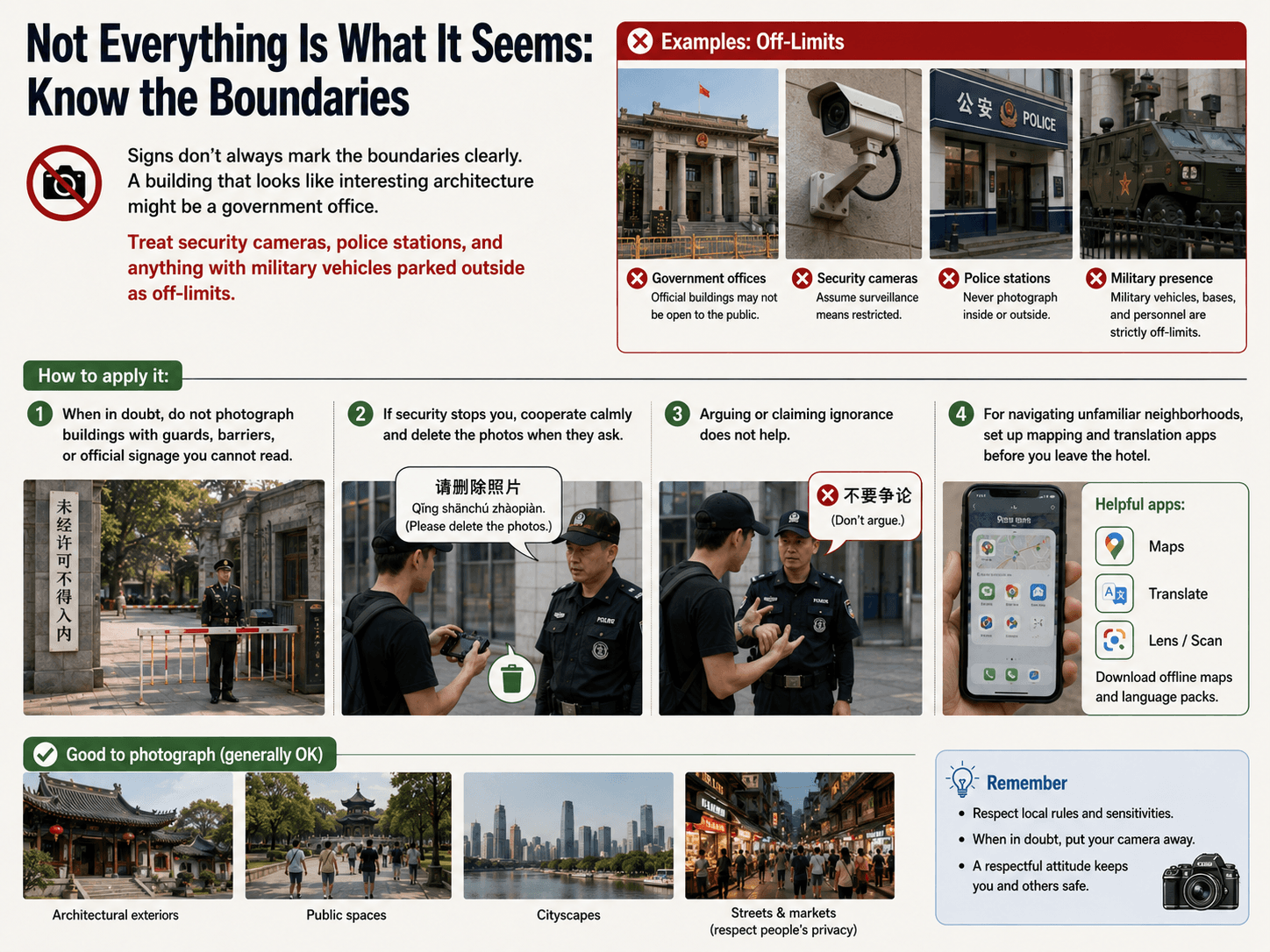
5. Government Buildings, Military Sites, and Security Infrastructure
Why it matters: This is one area where the consequences of getting it wrong escalate beyond social discomfort. Photographing military installations, certain government buildings, and security checkpoints can get you stopped by police or security personnel who will ask you to delete images.
What it looks like today: Signs don’t always mark the boundaries clearly. A building that looks like an interesting piece of architecture might be a government office. Treat security cameras, police stations, and anything with military vehicles parked outside as off-limits.
How to apply it: When in doubt, do not photograph buildings with guards, barriers, or official signage you cannot read. If security stops you, cooperate calmly and delete the photos when they ask. Arguing or claiming ignorance does not help. For navigating unfamiliar neighborhoods, setting up mapping and translation apps before you leave the hotel can help you identify what you are looking at before you raise your camera.
6. The Subway, Buses, and Public Transit
Why it matters: Public transit in China is efficient, crowded, and puts people in close physical proximity without giving them a choice. Photographing or filming fellow passengers, especially during rush hour, reads as invasive. It also risks capturing someone in an unflattering moment they did not consent to.
What it looks like today: Domestic social media in China has seen backlash against “subway creepshots” (地铁偷拍), and public awareness of image rights on transit is high. Some metro systems have signage discouraging photography of other passengers.
How to apply it: Photograph station architecture, maps, and signage freely. Avoid pointing your camera at seated or standing passengers. If you want to document the experience of riding the metro, film the platform or train exterior. For a full breakdown of subway etiquette and procedures , including security and payment, plan ahead.
7. Restaurants and Dining Situations
Why it matters: Photographing your own food is completely normal in China. The entire culture of food photography on platforms like Xiaohongshu (小红书) and Douyin means nobody will bat an eye at you snapping your hotpot. But photographing other diners, the kitchen staff, or the restaurant interior in a way that captures other tables crosses a line.
What it looks like today: Food photography is universal. People photography at restaurants is not. The distinction is about subject, not setting.
How to apply it: Photograph your dishes, your table, your companions. If the restaurant has beautiful decor, photograph it when other diners are not prominently in frame. Do not photograph kitchen staff without asking. In upscale restaurants, expect other diners to value privacy more than in a casual noodle shop.
8. Crowds, Protests, and Sensitive Gatherings
Why it matters: This is the highest-stakes scenario on this list. Photographing any form of public demonstration, labor dispute, or organized gathering in China can put both you and the participants at risk. This is not a matter of etiquette. It is a matter of personal safety and the safety of others.
What it looks like today: Gatherings that might look like a protest could be a labor dispute, a consumer complaint action, or a neighborhood petition. Outsiders often can’t read the context. Photographing or filming these situations and posting them online can have serious consequences for the people involved.
How to apply it: If you encounter a crowd that appears to be involved in any form of collective action or dispute, put your camera away and leave the area calmly. Do not photograph, do not film, do not livestream. This is not censorship advice. It is practical guidance for your safety and theirs.
The Pattern Underneath These Rules
Three themes run through every situation above. First, people assume you need consent — it’s not already given. China’s legal framework and cultural norms both default to the idea that your image belongs to you, not to whoever holds the camera. Second, context determines everything. The same action (photographing a person) is welcome in one setting and offensive in another. A vendor who just sold you dumplings may happily pose. A stranger on the subway will not.
Third, the power dynamic matters. A foreign visitor with an expensive camera photographing a local worker or elderly person carries an inherent imbalance. 74% of travelers say they want their travel choices to have a positive impact on destinations. Recognizing this dynamic is where that intention becomes real. Photography etiquette in China comes down to treating every person in your frame as a participant, not a subject.
Where to Start
You do not need to memorize all eight scenarios before you land. Start with three principles: ask before photographing individuals, default to no in temples and on transit, and put the camera away near anything that looks official or sensitive. These three habits will keep you out of trouble in 90% of situations.
As you get more comfortable, you will develop a feel for when a photo is welcome and when it is not. That instinct is worth more than any rule list. For deeper guidance on navigating daily life in China as a foreign visitor, ChinaTravelMag covers the practical gaps that generic travel guides skip, from international travel customs to digital payment setup to the unwritten social rules that shape your experience on the ground.
Frequently Asked Questions
Sources
- https://www.booking.com/sustainable-travel-report.html
- https://www.theworldofchinese.com/2023/07/the-battle-over-privacy-in-chinese-street-photography/
- https://chinatravelmag.com/the-essential-apps-that-replace-your-credit-cards-google-maps-and-english-menus-before-you-leave-the-hotel/
- https://chinatravelmag.com/chinese-metro-guide-security-alipay-escalator-rules-local-tips/
- https://www.expediagroup.com/insights/traveler-value-index/
- https://www.chinatravelmag.com