Navigate seating, toasting, chopsticks, and the bill with confidence at every stage of the meal
Learn how to handle every social moment of a Chinese dinner, from seating hierarchy and ordering protocol to toasting rituals and the bill-paying dance. This step-by-step guide turns mindful travel behavior into confident, respectful dining.
TL;DR
- Let the host lead everything – They choose the seats, order the food, make the first toast, and pay the bill. Your job is to follow graciously and express genuine thanks.
- Seating has a hierarchy – The seat facing the door is the seat of honor. Never sit until directed. When in doubt, ask where you should sit.
- Master three chopstick rules – Never stick them upright in rice, don’t point with them, and don’t dig through shared dishes. Everything else is forgivable.
- Toast with something, even if it’s tea – Refusing a toast outright creates awkwardness. Hold your glass lower than the other person’s to show respect, and say “Suíyì” if you want to sip rather than drain the glass.
- Leave a little food on your plate – A clean plate signals the host didn’t order enough. A small amount of leftover food means you were well fed and the host was generous.
What You’ll Walk Away With
By the end of this guide, you’ll know exactly how to handle every social moment of a Chinese dinner, from walking through the door to settling the bill. No guessing, no awkward pauses. You’ll understand seating hierarchy, how to order without overstepping, the right way to handle toasts, chopstick etiquette that actually matters, and the bill-paying ritual that confuses almost every foreign visitor.
Your success criteria are simple: you finish the meal feeling like you belonged at that table. Your Chinese hosts feel respected. Nobody had to quietly correct you. That’s the goal, and it’s completely achievable with some preparation and mindful travel behavior that treats a dinner table like the cultural space it is.
Prerequisites: What You Need Before Sitting Down
No special tools required here, just some awareness and a willingness to pay attention. Budget about 15 minutes to read this guide, then mentally rehearse the sequence before your dinner.
- WeChat installed and working — You’ll likely need it to add contacts, split payments, or scan a menu QR code. If you haven’t set this up yet, do it before your trip.
- Basic phrases (optional but appreciated) — “Xièxie” (thank you), “Gānbēi” (cheers/bottoms up), and “Hǎo chī” (delicious) go a long way.
- An open schedule — Chinese dinners run long. Plan for 1.5 to 3 hours, especially if it’s a business or hosted meal.
- Comfortable clothing — You may be sitting on low stools at a hotpot place or in a private banquet room. Dress smart-casual unless told otherwise.
- No full stomach — Arrive hungry. The food will keep coming.
Time estimate: 15 minutes to read, a lifetime of less awkward dinners.
Why This Approach: Treating Dinner as a Sequence, Not a Rulebook
Most etiquette guides hand you a list of do’s and don’ts, then leave you to figure out when each rule applies. That doesn’t work at a real dinner because social moments unfold in order. You need to know what matters right now, at each phase of the meal.
This guide walks you through a Chinese dinner chronologically, the way you’ll actually experience it. Each step is a decision point where you can either blend in or accidentally signal something you didn’t intend. Research on mindful travel frames this well: being present, intentional, and connected with your environment is what separates a respectful guest from a clueless tourist.
With more than half of surveyed travelers now saying they prefer to eat at locally owned businesses while traveling abroad, the odds are good you’ll find yourself at an authentic Chinese dinner. Here’s how to handle it.
Step-by-Step: Navigating a Chinese Dinner Without Missteps
Step 1: Arrival and Greetings
Action: Arrive on time or 5 to 10 minutes early. Greet the host first, then greet others in approximate order of seniority (older before younger, higher rank before lower). A slight nod, a smile, and a handshake are all fine for foreigners. You don’t need to bow.
Expected result: The host acknowledges you warmly and begins directing people toward the table. If someone offers you a business card, accept it with both hands and glance at it before putting it away respectfully.
Common failure: Arriving late without notice. In China, punctuality signals respect. If you’re running behind, message the host on WeChat immediately. Don’t just show up 20 minutes late and shrug it off.
Step 2: Seating — Find Your Place, Don’t Choose It
Action:Do not sit down until directed. In most Chinese dining settings, especially at round tables with a lazy Susan, seating has a hierarchy. The seat facing the door is the “seat of honor” (主位, zhǔ wèi), reserved for the highest-ranking person or the most important guest. The host typically sits opposite, facing away from the door.
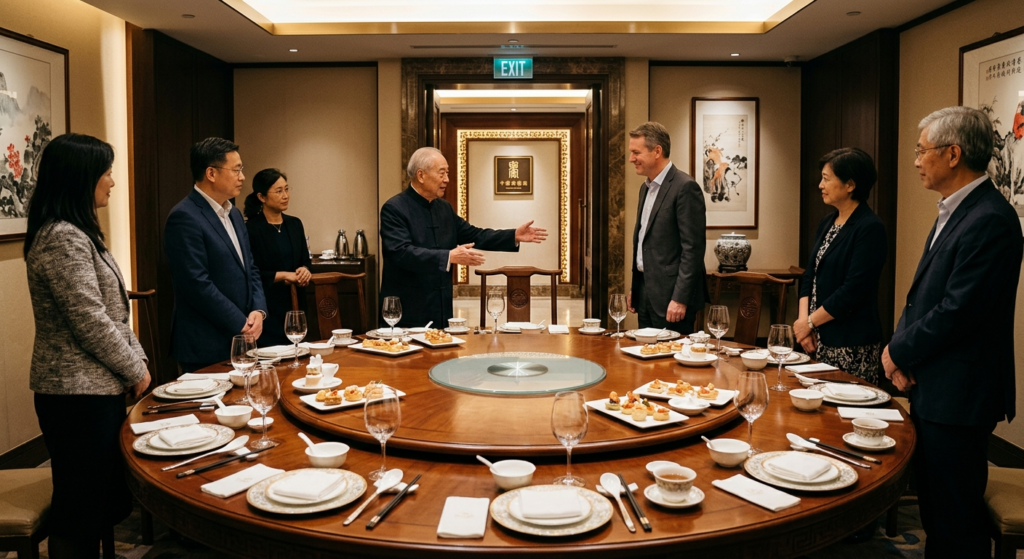
Expected result: The host or a senior person will gesture you toward your seat. If you’re the guest of honor, you’ll be guided to the seat facing the entrance. Accept it graciously.
Common failure: Sitting in the host’s seat or the seat of honor uninvited. If no one directs you, stand near the table and wait. Ask “Where should I sit?” (我坐哪里?Wǒ zuò nǎlǐ?) if things stall. Nobody will think less of you for asking.
Checkpoint: You’re seated. Others are settling in. The host looks relaxed. You’re in the right spot.
Step 3: Tea Service — Accept, Don’t Pour for Yourself First
Action: Tea usually arrives before the food. If someone pours tea for you, tap two fingers lightly on the table near your cup. This is a common gesture of thanks across China (it originates from a Qing Dynasty story, but the practice is universal today). When the teapot is near you, pour for others before filling your own cup.
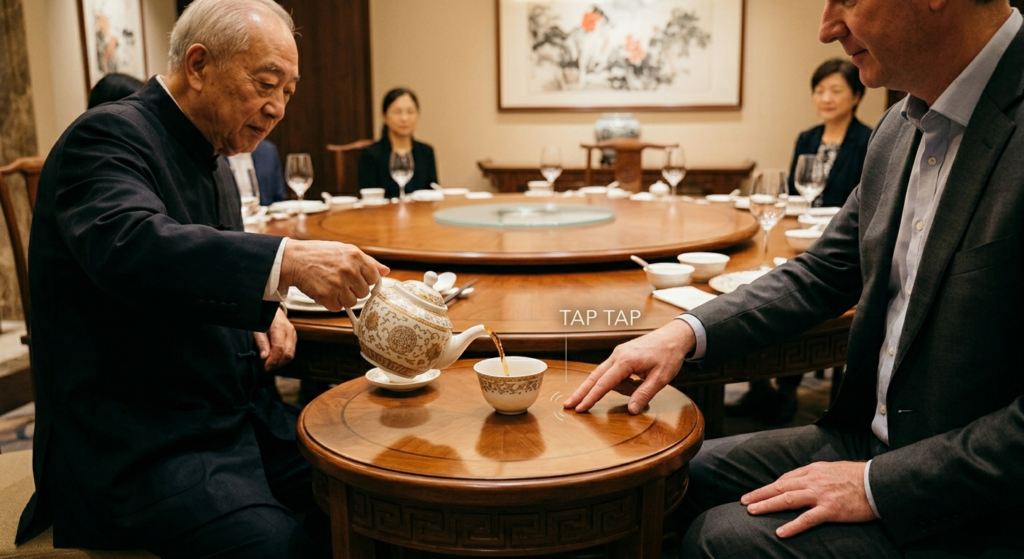
Expected result: A small, natural exchange of courtesy. Nobody makes a big deal of it, but everyone notices if you do it right.
Common failure: Filling your own cup first, or ignoring the teapot when it’s clearly near you. Both read as self-centered. Also, don’t tap the table loudly or dramatically. Two gentle taps with your index and middle finger is enough.
Step 4: Ordering — Let the Host Lead
Action:The host orders for the table. This is not a situation where everyone picks their own dish. Chinese meals are communal: dishes go in the center and everyone shares. If the host asks for your preferences or dietary restrictions, answer honestly. Saying “I can’t eat shellfish” is far better than silently suffering through an allergic reaction.
Expected result: The host orders a spread that balances meat, vegetables, seafood, soup, and a starch (rice or noodles, usually arriving last). You may be asked if you’d like to add anything. Suggesting one dish is fine. Rewriting the order is not.
Common failure: Grabbing the menu and ordering independently, or insisting on separate dishes. This undermines the host’s role and can cause genuine embarrassment. If you’re dining at a casual restaurant with peers (not a hosted dinner), the dynamic is more flexible, but still let the most senior person or the person who organized the meal take the lead.=
Tip: Many restaurants in China now use QR code menus on WeChat. If the menu is entirely in Chinese, ChinaTravelMag recommends using your phone’s camera translation feature or asking your host to walk you through the highlights. Hosts generally enjoy explaining regional dishes.
Step 5: The First Dish Arrives — Wait for the Cue
Action: When the first dish hits the table, do not start eating immediately. Wait for the host to invite everyone to begin. They’ll usually say something like “大家吃吧” (Dàjiā chī ba, “Everyone, let’s eat”) or gesture toward the food. The guest of honor is often invited to take the first bite.
Expected result: The host signals, the table starts eating, and you join in naturally.
Common failure: Digging in the moment food appears. This is one of the most common dining out manners mistakes foreigners make at Chinese dinners. It’s not catastrophic, but it’s noticeable.
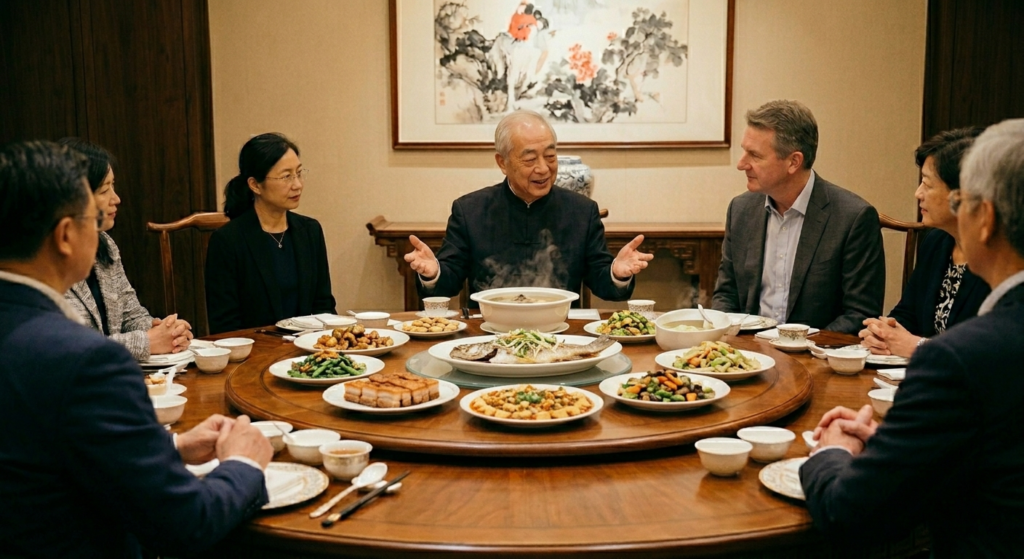
Step 6: Chopstick Etiquette — The Rules That Actually Matter
Action: Use chopsticks for eating. Here are the non-negotiable rules:
- Never stick chopsticks vertically into a bowl of rice. This resembles incense offerings for the dead. It’s the single most important chopstick rule.
- Don’t point at people with your chopsticks.
- Don’t dig through a shared dish hunting for the best piece. Take what’s on top or nearest to you.
- Use the serving spoon or communal chopsticks if provided, especially at formal meals.
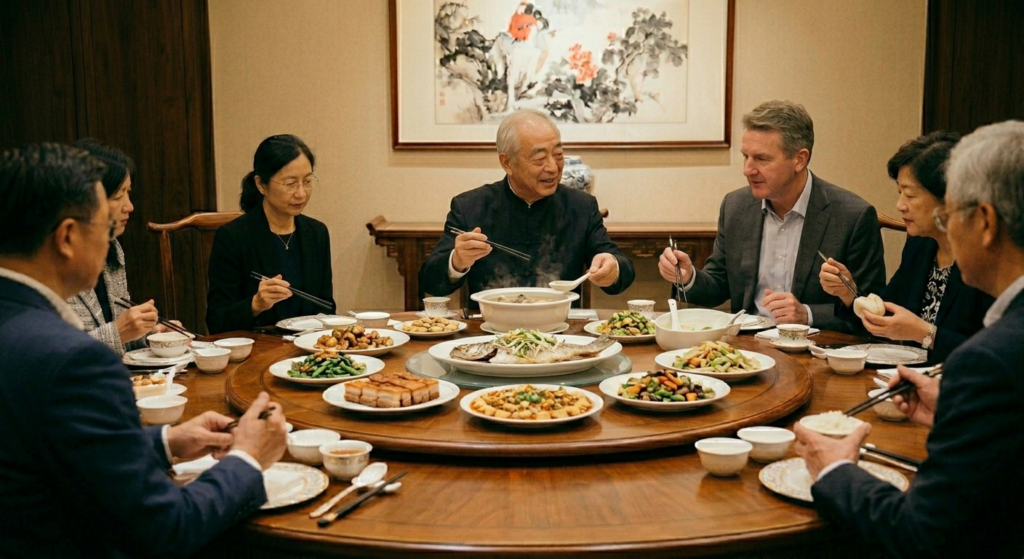
Expected result: You eat comfortably without drawing attention to your technique. If you’re not great with chopsticks, that’s okay. Most Chinese hosts find it endearing when a foreigner tries. If you truly struggle, asking for a fork is far better than launching food across the table.
Common failure: Spearing food with a single chopstick. It works mechanically but looks rough. Practice the basic grip before your trip.
Lazy Susan do’s and don’ts – Many Chinese tables have a revolving glass tray (the “Lazy Susan”). Wait until everyone at the table has taken what they want before you spin it. When you do spin, go slowly and avoid spinning it just for your favorite dish. Never spin it while someone is reaching for food. If you’re unsure, simply push the dish you want toward yourself instead of sending the whole tray spinning.
Step 7: Toasting — The Social Engine of the Meal
Action: Toasting (敬酒, jìng jiǔ) is where relationships are built at Chinese dinners. The host will likely make the first toast. When clinking glasses, hold your glass lower than the other person’s to show respect, especially if they’re older or more senior. Say “Gānbēi” (干杯, literally “dry cup”) if you’re comfortable drinking the full glass, or “Suíyì” (随意, “as you wish”) if you’d prefer to sip.
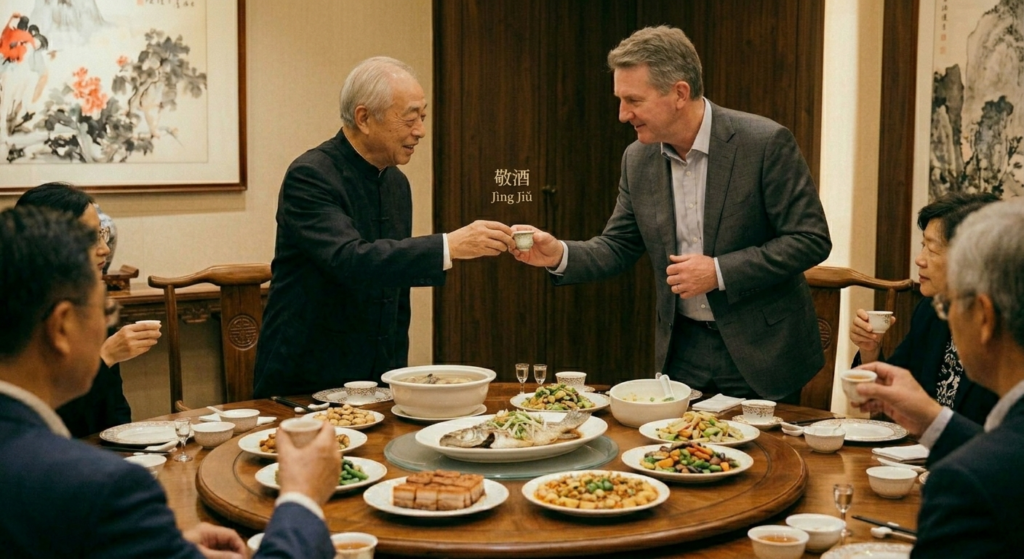
Expected result: You participate in toasts without over-drinking or appearing standoffish. Expect multiple rounds. It’s common to toast the host, then be toasted individually, then toast others at the table.
Common failure: Refusing all alcohol without explanation. If you don’t drink, say so early and clearly: “I don’t drink alcohol, but I’d love to toast with tea (or juice).” This is widely accepted today. What causes awkwardness is ambiguity, saying “maybe later” and then never drinking, which can feel like a rejection.
Important note: At business dinners, baijiu (白酒, a strong grain liquor) is common. It’s potent. Pace yourself. Nobody respects the guest who gets visibly drunk.
Step 8: During the Meal — Receiving Food Gracefully
Action: Your host (or others at the table) will likely place food on your plate. This is a gesture of care, not an attempt to force-feed you. Accept it with a thank you. You don’t have to eat every piece, but refusing outright or making a face is rude.
Expected result: Your plate stays reasonably full throughout the meal. The host feels good about feeding you well.
Common failure: Saying “No, no, I’m fine” repeatedly when someone offers food. In Chinese dining culture, a certain amount of insistence is expected. Accept at least some of what’s offered. If you genuinely can’t eat something (allergies, dietary restrictions), a brief, honest explanation is perfectly fine.
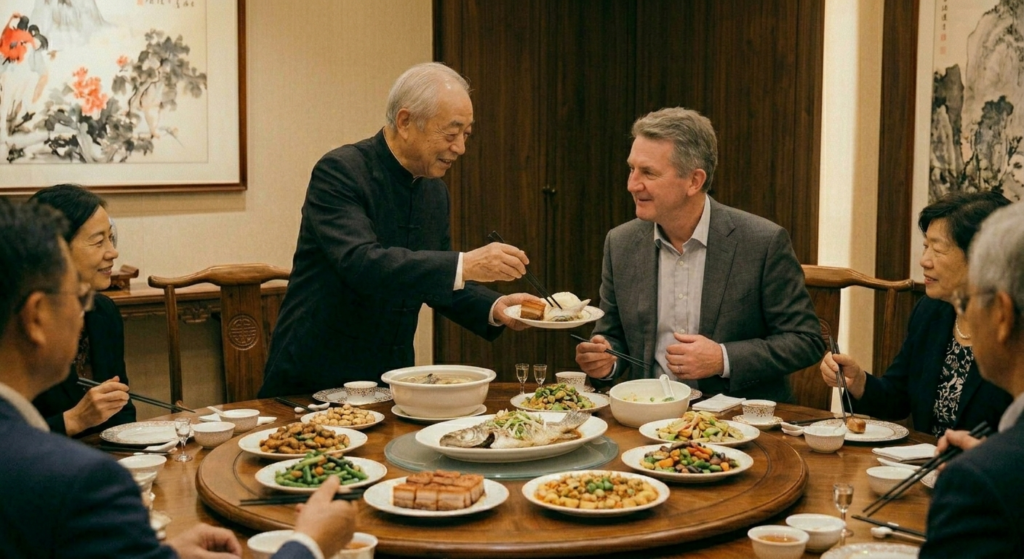
What to do with bones, pits, or shells – Many Chinese dishes contain small bones (fish, chicken) or fruit pits. It’s perfectly fine to spit them out discreetly, but never directly onto the table. Use your personal bone plate (the small plate next to your bowl) or a napkin. If no bone plate is provided, ask the server or your host. Spitting into a tissue and placing it on the edge of your own plate is also acceptable. What looks rough is spitting onto the tablecloth or the floor – avoid that.
When you are truly full – The host may keep adding food to your plate even after you’ve said “I’m full.” This is an expression of care. Instead of refusing aggressively, let the food stay on your plate for a while. If it keeps happening, cover your bowl lightly with your hand, smile, and say a warm “Thank you, I really can’t eat another bite – it was delicious.” You can also leave the last piece of food on your plate uneaten as a visible signal. A flat-out “No!” or pushing the host’s hand away would be rude; a gentle, repeated “谢谢, 我饱了” (Xièxie, wǒ bǎo le – “Thanks, I’m full”) works beautifully.
If you’re curious about how immersive Chinese dining experiences can get, this review of an immersive dining show in Chongqing captures the theatrical end of the spectrum.
Step 9: Finishing the Meal — Don’t Clean Your Plate
Action: Here’s one that trips up many Western visitors. Leaving a small amount of food on your plate and on the shared dishes signals that the host ordered generously enough. A completely empty table can imply the host didn’t provide enough food, which causes a loss of “face” (面子, miànzi).
Expected result: A few bites remain on your plate. Shared dishes still have some food left. The host looks satisfied.
Common failure: Cleaning every plate spotless out of politeness (common Western instinct) or, conversely, leaving enormous amounts uneaten, which suggests you didn’t enjoy the food. Aim for a middle ground: eat well, leave a little.
Step 10: The Bill — Don’t Even Reach for It
Action: If you were invited to the dinner, the host pays. Period. This is one of the strongest social norms in Chinese dining culture. The host will often settle the bill discreetly, sometimes leaving the table briefly to pay at the counter or handling it on WeChat Pay before anyone notices.
Expected result: The bill disappears without discussion. You express genuine thanks.
Common failure: Insisting on splitting the bill or “getting your share.” In Western cultures, this feels fair. In China, it can undermine the host’s generosity and cause an uncomfortable standoff. A brief, token offer (“Please, let me contribute”) is polite. But when the host declines, accept gracefully. If you want to reciprocate, invite them to a meal another time.
If you’re the host: The expectation flips entirely. You order, you pay, and you don’t let your guests see the bill. This is your role.
Configuration and Customization: Adjusting for Context
Not every Chinese dinner is the same. Here’s how the rules flex depending on the situation:
- Formal business dinner: All rules above apply at maximum intensity. Seating hierarchy is strict. Toasting is extended and strategic. Baijiu is likely. Dress well.
- Casual dinner with friends or peers: Seating is relaxed. Ordering is more collaborative. Bill-splitting might actually happen (via WeChat Pay, with one person paying and others transferring their share). The vibe is looser, but the chopstick rules and food-sharing norms still apply.
- Hotpot: Everyone cooks their own food in a shared pot. The ordering is more democratic. It’s inherently casual. But the host still usually pays, and you should still pour tea for others.
- Family dinner at someone’s home: Bring a gift (fruit, tea, or a nice bottle of something). Remove your shoes if the family does. Compliment the cooking. Offer to help clean up (expect to be refused, but offer).
Safe defaults that work everywhere: Let the host lead. Accept food graciously. Don’t stick chopsticks in rice. Express thanks often.
Verification: How to Know You Did It Right
After the meal, check these signals:
- The host seems relaxed and happy. If they’re smiling and suggesting future plans, you nailed it.
- Nobody awkwardly corrected you during the meal. Chinese hosts are often too polite to correct guests openly, but you may notice gentle redirections (“Oh, try this one instead”). Fewer of those means you were on track.
- You were invited again. The ultimate confirmation.
- You didn’t feel lost at any point. If you followed the sequence above, you had a framework for every moment.
Test yourself on edge cases: What if two people try to pay? (Let them resolve it; don’t jump in.) What if you’re served something you’ve never seen? (Try a small bite, smile, and compliment it.) What if you accidentally break a chopstick rule? (Move on quietly. Nobody expects perfection from a foreign guest.)
Common Errors and Fixes for Dining Out Manners in China
- Symptom: Host looks uncomfortable after you sit down. Cause: You sat in the seat of honor or the host’s seat without being directed. Fix: Always wait to be seated. If you realize mid-meal, there’s nothing to do but remember for next time.
- Symptom: Awkward silence after you refuse a toast. Cause: You declined without offering an alternative. Fix: Always toast with something, even tea or water. The gesture matters more than the liquid.
- Symptom: Your host keeps putting more food on your plate even though you’re full. Cause: Your plate is empty, signaling you haven’t had enough. Fix: Leave a small amount of food on your plate to signal you’re satisfied.
- Symptom: A tense moment when the bill arrives. Cause: You insisted too aggressively on paying or splitting. Fix: Make one polite offer, then defer to the host with a warm “Thank you, next time is on me.”
- Symptom: Visible discomfort from others at the table when you use chopsticks. Cause: Likely sticking them upright in rice or pointing with them. Fix: Rest chopsticks flat on the chopstick rest or across the top of your bowl when not eating.
Next Steps: Going Deeper
Now that you can handle a standard Chinese dinner, consider expanding your comfort zone. If you’re traveling abroad by high-speed train in China, you’ll encounter dining cars and station restaurants with their own rhythms. Regional cuisines vary dramatically: a Cantonese dinner in Guangzhou operates differently from a Sichuan hotpot in Chengdu.
Three ways to build on this foundation:
- Learn 10 food-related Mandarin phrases. Being able to say “This is delicious” (这个很好吃, Zhège hěn hǎo chī) or “I’m allergic to…” (我对…过敏, Wǒ duì…guòmǐn) elevates your presence at the table.
- Host a return dinner. Inviting your Chinese friends or colleagues to a meal you organize (and pay for) is the strongest form of reciprocity.
- Explore regional dining customs. Tea ceremony etiquette in Fujian, lamb banquets in Inner Mongolia, and dim sum protocol in Hong Kong each have their own rules worth learning.
FAQ
Sources
- https://www.ie.edu/center-for-health-and-well-being/blog/mindful-travel-discover-the-power-of-conscious-journeys-for-well-being/
- https://www.travelmarketreport.com/retail-strategies/articles/survey-reveals-americans-seek-mindful-travel-in-2024
- https://www.chinatravelmag.com
- https://en.wikipedia.org/wiki/Chinese_table_manners
- https://chinatravelmag.com/chongqing-liyan-baguo-huayan-banquet-etiquette-of-the-eight-kingdoms/
- https://chinatravelmag.com/a-foreigners-guide-to-taking-high-speed-trains-in-china/