Why the unwritten rules on a Beijing subway don’t match what Western visitors expect — and what actually applies
Learn the unwritten public transportation etiquette rules governing Chinese subways, buses, and streets. This guide reframes behaviors like pushing, noise, and personal space as a distinct cultural operating system, giving you a practical framework for reading social cues in real time.
📌 TL;DR
- It’s a different system, not a broken one – Chinese public transit norms prioritize collective flow over individual comfort. Assertive boarding, physical contact, and ambient noise are features of the system, not failures of politeness.
- Watch, then match – Spend your first ride observing how locals board, exit, stand, and interact. Then mirror the pace and behavior. You’ll adapt faster through observation than through any fixed rule set.
- Keep moving, always – Stopping in corridors, doorways, or at the top of escalators is the single most disruptive thing a visitor can do. Pull to the side if you need to check your phone or get your bearings.
- Offer seats through action, not words – Stand up and step aside for elderly passengers. Don’t make a verbal production of it. Accept refusals gracefully.
- Set up digital payment before you arrive – China’s transit is largely cashless. Alipay and WeChat Pay are essential, not optional. Sort this out before your first subway ride.
Guide Orientation: What This Covers and Who It’s For
This guide breaks down the unwritten public transportation etiquette rules that govern daily life on subways, buses, and streets in Chinese cities. It’s written for Western visitors (primarily from North America and Europe) who are traveling to China for the first time or returning after a long gap.
By the end, you’ll understand why certain behaviors that feel rude by Western standards are perfectly normal in China, why some habits you consider polite will confuse people, and how to move through public spaces without unnecessary friction. You’ll also have a practical framework for reading social cues in real time.
This guide focuses on transit and public spaces in major cities like Beijing, Shanghai, Guangzhou, and Chengdu. It does not cover formal dining etiquette, business protocol, or rural customs, though some principles overlap.
Why Cultural Awareness in Travel Actually Matters Here
China’s public spaces operate on a logic that is internally consistent but externally invisible to most Western visitors. The gap isn’t about politeness versus rudeness. It’s about two different operating systems running side by side, each with its own assumptions about personal space, noise, urgency, and obligation to strangers.
The Beijing Subway carries more than 10 million passengers daily , making it one of the busiest metro systems on the planet. At that density, the Western convention of maintaining arm’s-length personal space isn’t just impractical; it’s physically impossible. The system has evolved its own flow patterns, boarding rituals, and social contracts to handle that volume. Visitors who don’t understand those patterns don’t just feel awkward. They create bottlenecks, miss trains, and occasionally cause real frustration for the people around them.
The cost of misreading these norms isn’t catastrophic. Nobody will arrest you for standing on the wrong side of an escalator. But the cumulative effect of a dozen small misreadings per day is exhaustion, self-consciousness, and the nagging sense that you’re doing everything wrong. This guide exists to replace that feeling with clarity.
Most English-language etiquette content about China is either decades out of date or so generic it could apply to any country. The reality on the ground in a modern Chinese city is specific, fast-moving, and worth understanding on its own terms.
Core Concepts: The Operating System Behind the Behavior
Collective Flow vs. Individual Courtesy
Western public transit norms tend to prioritize the comfort of the individual: don’t touch me, don’t talk loudly near me, let me have my personal bubble. Chinese transit norms prioritize the movement of the group: keep the flow going, don’t block the path, fill available space efficiently. Neither system is more “polite.” They optimize for different outcomes.
Context-Dependent Rules
In many Western cities, the same basic etiquette applies whether you’re on a rush-hour train or an empty Sunday bus. In China, context shifts the rules significantly. What’s acceptable at 8:30 a.m. on Line 1 in Beijing (aggressive boarding, body contact, zero personal space) would be unusual at 2 p.m. on the same train. Reading the room matters more than memorizing a fixed set of rules.
Noise as Neutral, Not Aggressive
Phone calls on speakerphone, videos played without headphones, loud conversations: these register as aggressive or inconsiderate to most Western visitors. In Chinese public spaces, ambient noise is treated as a shared background condition, not a personal intrusion. The expectation isn’t silence; it’s tolerance. This is shifting in some cities (Shanghai’s metro now has quiet-car campaigns), but the baseline remains significantly different from what visitors expect.
The Misconception of Rudeness
The single most common travel faux pas Western visitors make isn’t a specific behavior. It’s interpreting Chinese public behavior through a Western moral framework. When someone pushes past you to board a train, they’re not being rude to you. They’re participating in a system where hesitation means missing the train. The behavior isn’t personal. It’s procedural.
The Framework: Four Layers of Public Space Navigation
Think of Chinese public transit behavior as operating on four layers, each one building on the last:
- Infrastructure Layer: Security checks, payment systems, physical layout. These are the hard rules you must follow.
- Flow Layer: Boarding patterns, walking speed, escalator positioning. These are the soft rules that keep everything moving.
- Social Layer: Noise norms, phone use, seat priority. These are the cultural defaults that vary by city and time of day.
- Interaction Layer: How to respond when someone bumps you, talks to you, or offers you something. These are the moments where your reaction reveals your understanding.
The steps below walk through each layer with specific guidance for what to do, what to avoid, and how to tell if you’re getting it right.
Step-by-Step: How to Navigate Public Transit Norms in China
Step 1: Clear the Infrastructure Layer Without Slowing Anyone Down
Objective: Move through security screening, ticket purchase, and gate entry at the pace the system expects.
Every subway station in China requires a security check at entry. Your bags go through an X-ray scanner, and you may walk through a metal detector or receive a brief wand scan. This is non-negotiable and happens every single time you enter a station. The process is fast, but only if you’re ready for it.
Have your bag off your shoulder and in your hand before you reach the belt. Don’t stop to rearrange belongings on the other side of the scanner; grab your bag and keep walking. The line behind you is constant, and hesitation here creates a visible ripple.
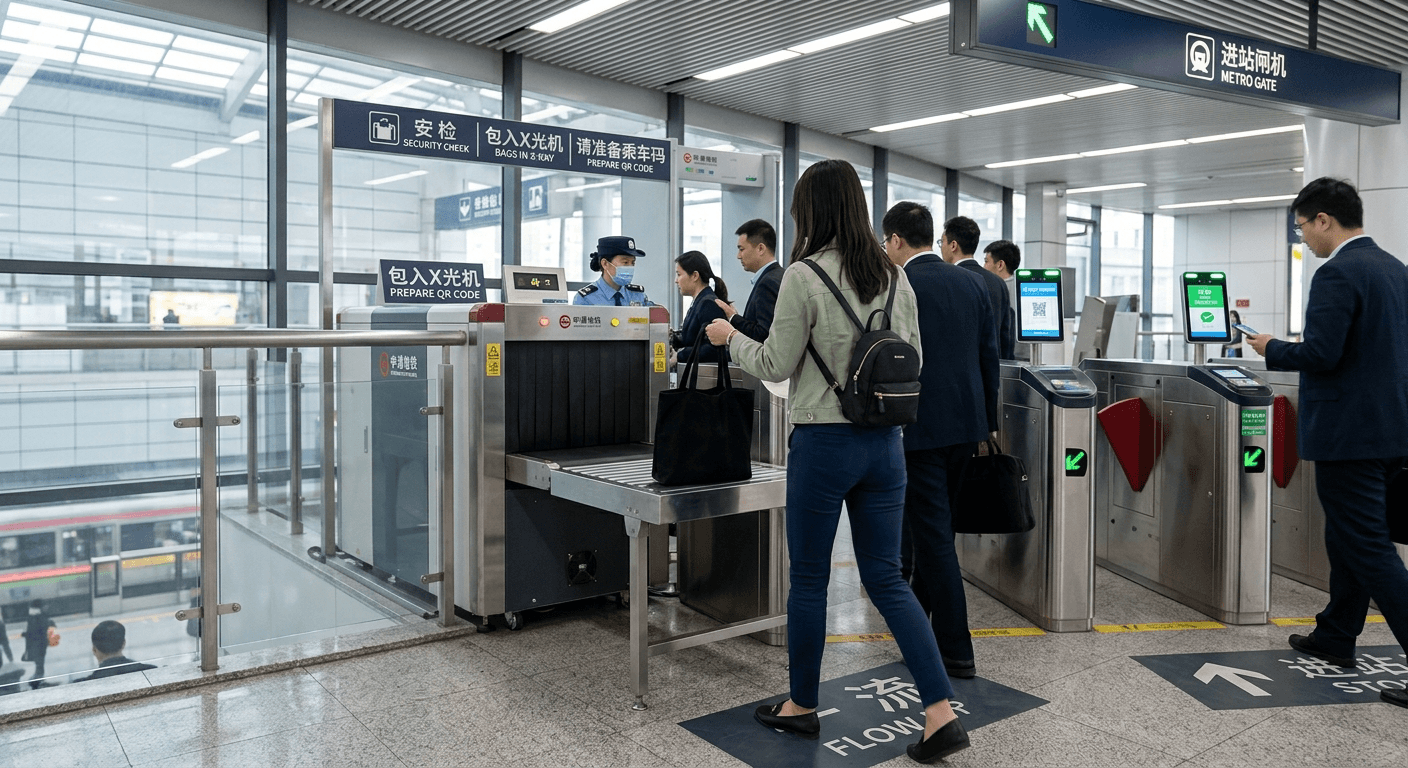
Payment is almost entirely digital. China’s transit systems are largely cashless, with Alipay and WeChat Pay accepted on metro and bus systems across major cities. If you haven’t set up mobile payment before arriving, you’ll need to sort that out first. Setting up Alipay and WeChat as an international visitor takes some preparation, but it eliminates the daily friction of trying to buy single-journey tickets at machines with limited English.
Anti-patterns: Fumbling for your bag at the scanner. Trying to pay with cash at a turnstile while a queue forms behind you. Stopping immediately after passing through the gate to check your phone for directions.
Success indicators: You clear security and enter the platform in under 90 seconds. Nobody behind you has to wait or step around you.
Step 2: Master the Boarding Ritual
Objective: Board and exit trains using the actual flow pattern, not the one you assume exists.
Beijing and Shanghai subway platforms have floor markings showing exactly where doors will open. These markings also indicate where to stand: to the left and right of the doors, leaving a clear center channel for exiting passengers. This system works well when everyone follows it, and most regular commuters do.
The critical difference from Western boarding: once the doors open and exiting passengers clear, boarding is fast and assertive. There is no orderly single-file line. People move in as a group, filling available space. If you hang back waiting for a polite pause, you will not board. This is not aggression. It is the system working as designed for a network where trains arrive every 1.5 to 4 minutes during peak hours .
During rush hour, expect physical contact. Shoulders, backpacks, and elbows will press against you. This is normal. Do not react with visible irritation or try to create a buffer of space around yourself; there is no space to give. Move to the center of the car if you’re not exiting soon. Standing near the doors when you don’t need to is one of the most disruptive things a visitor can do.
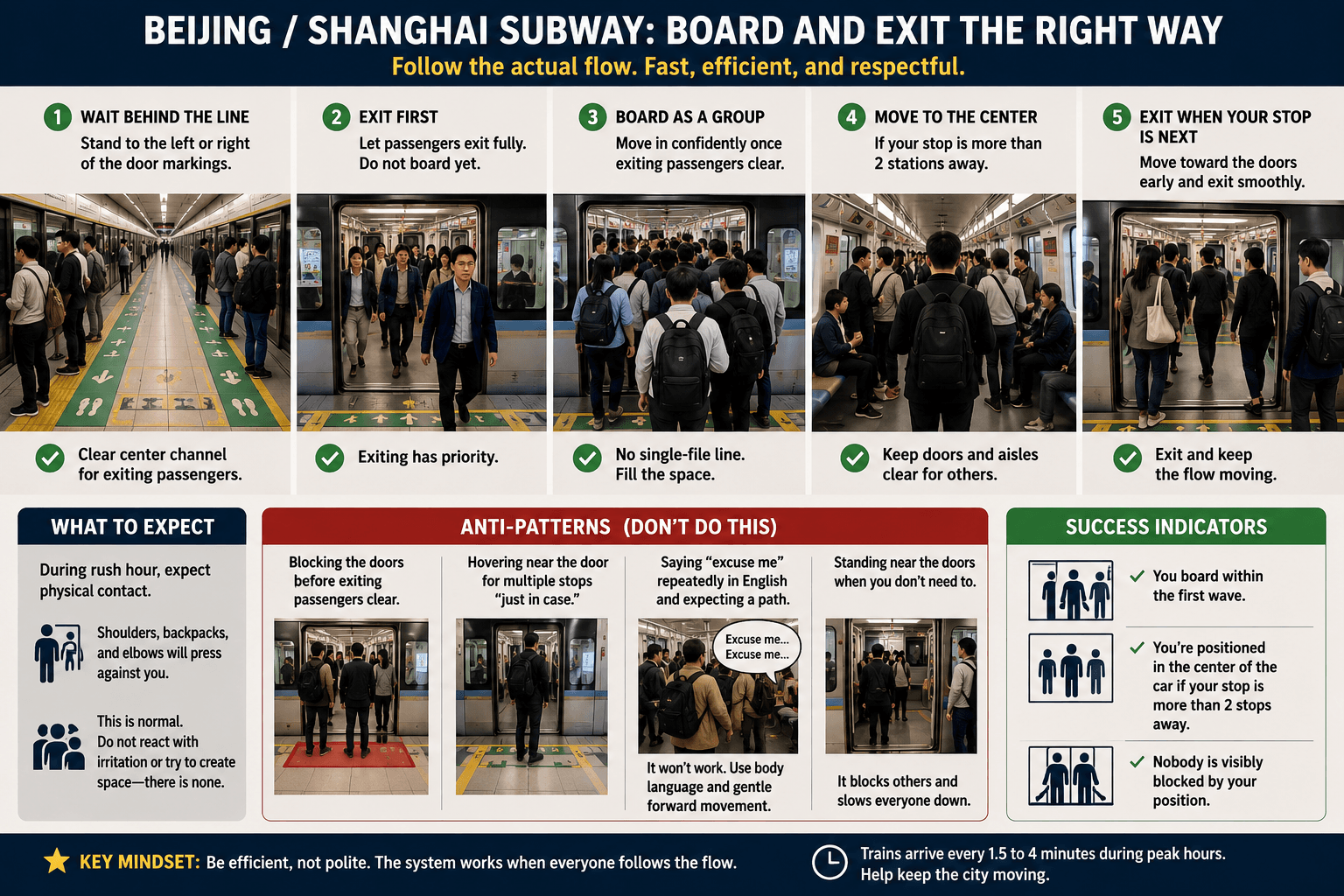
Anti-patterns: Standing directly in front of the doors waiting to board before passengers have exited. Hovering near the door for multiple stops “just in case.” Saying “excuse me” repeatedly in English and expecting it to clear a path (it won’t; use body language and gentle forward movement instead).
Success indicators: You board within the first wave. You’re positioned in the center of the car if your stop is more than two stations away. Nobody is visibly blocked by your position.
Step 3: Calibrate Your Noise and Phone Expectations
Objective: Stop interpreting ambient noise as personal rudeness and adjust your own behavior to match the actual environment.
On a typical Beijing or Shanghai subway car, you will hear multiple phone calls on speaker, video content playing without headphones, animated conversations at full volume, and children being children. Your Western instinct may be to feel annoyed or to assume everyone around you is being inconsiderate. Reframe: this is the ambient baseline, not a violation of norms.
That said, the norm is shifting unevenly. Shanghai has introduced quiet-ride campaigns on certain lines. Younger urban commuters in tier-one cities increasingly use earbuds. But the default expectation remains tolerance of noise, not enforcement of silence. You are not obligated to be silent yourself, but most visitors naturally are, and that’s fine. Nobody will judge you for being quiet.
Your own phone use is unrestricted. Scrolling, texting, watching videos: all normal. Making a call is normal. The one thing that does draw attention is a foreigner loudly FaceTiming in English, not because it’s rude, but because it’s conspicuous. If you want to blend in, text instead.
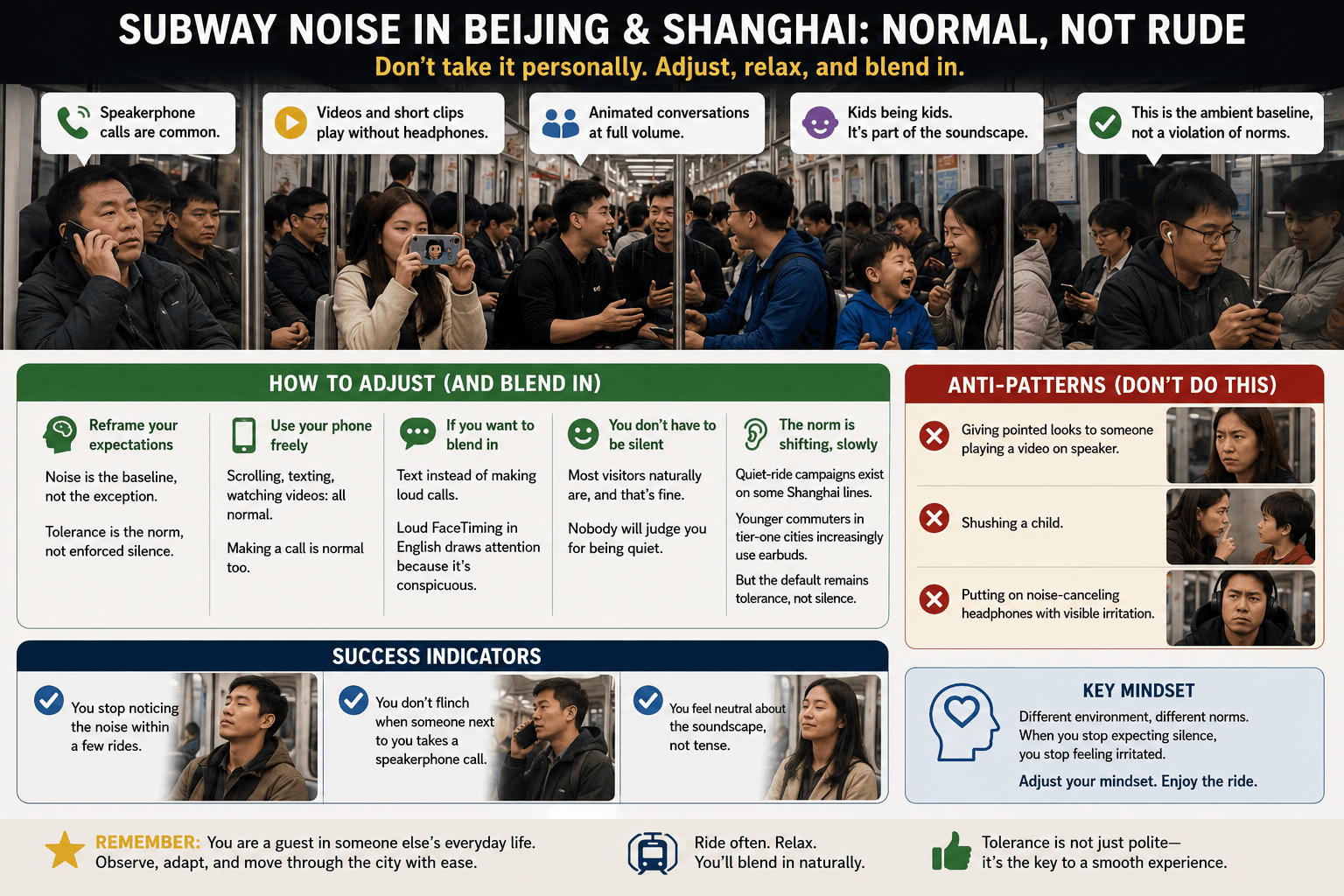
Anti-patterns: Giving pointed looks to someone playing a video on speaker. Shushing a child. Putting on noise-canceling headphones with visible irritation. These behaviors mark you as someone who doesn’t understand the environment.
Success indicators: You stop noticing the noise within a few rides. You don’t flinch when someone next to you takes a speakerphone call. You feel neutral about the soundscape, not tense.
Step 4: Understand the Real Priority Seating System
Objective: Know when to sit, when to stand, and when to offer your seat without creating an awkward scene.
Priority seats exist and are marked. Elderly passengers, pregnant women, and people with disabilities have formal priority. In practice, the system is more active than what most Western visitors are used to. It is common for younger passengers to stand up and physically gesture an older person into their seat without any verbal exchange. If you’re sitting and an elderly person boards, you should stand. Don’t ask if they want the seat. Just stand and step aside. The offer is made through action, not words.
Here’s where it gets nuanced: sometimes the older person will refuse. They may wave you off or insist you sit. This isn’t a test. Accept their refusal gracefully and sit back down. Insisting too hard creates discomfort for both of you.
If you’re a younger, visibly healthy adult sitting in a non-priority seat and the car is full, you may still feel social pressure to stand for an older passenger. This is real and appropriate. In Chinese transit culture, age-based deference is stronger and more automatic than in most Western systems.
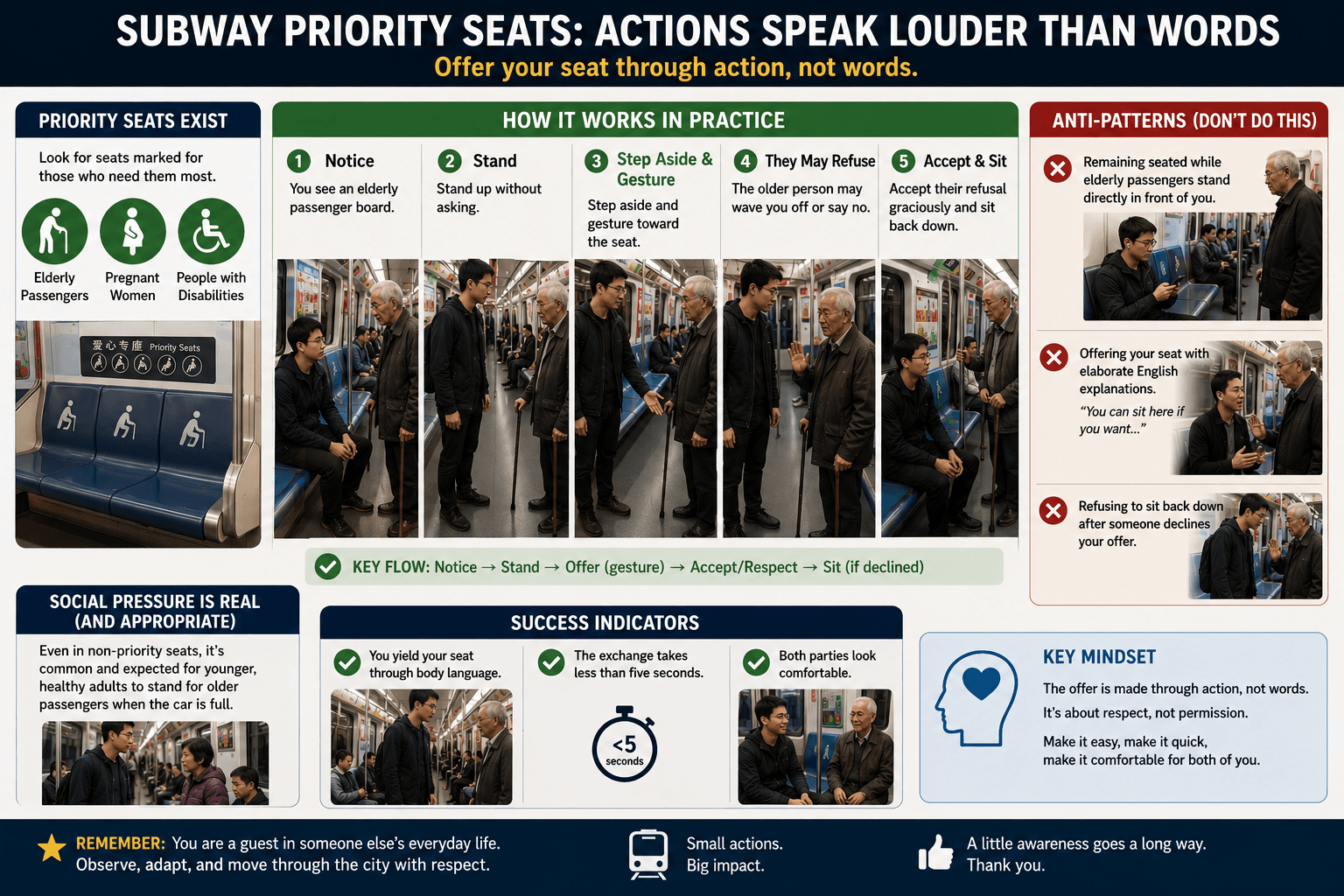
Anti-patterns: Remaining seated while elderly passengers stand directly in front of you. Offering your seat with elaborate English explanations. Refusing to sit back down after someone declines your offer.
Success indicators: You yield your seat through body language. The exchange takes less than five seconds. Both parties look comfortable.
Step 5: Navigate Physical Proximity Without Tension
Objective: Accept and participate in the physical reality of crowded public spaces without broadcasting discomfort.
Western visitors in China frequently describe feeling “pushed” or “shoved” on public transit. In most cases, what’s happening is not aggression. It’s efficient space management in a system serving millions of people daily. The amount of personal space that feels normal in a New York or London subway car is roughly double what you’ll get in Beijing or Guangzhou during peak hours.
On buses, the dynamic is even more compressed. City buses in Shanghai and Chengdu fill to capacity and beyond. Passengers press toward the back. Getting off requires assertive movement toward the door starting one stop before yours. If you wait until the doors open to start moving, you may not make it out.
The key mental shift: physical contact in transit is not communicative. It doesn’t mean anything. Nobody is trying to intimidate you or disrespect your boundaries. It’s the physics of too many people in a metal box. Respond with the same neutrality. Move with the flow. Use your body to create direction, not barriers.
For navigating bus routes and unfamiliar stops, Amap (Gaode Maps) is significantly more reliable than Google Maps for Chinese transit routing and will show you exactly which stop to exit at.
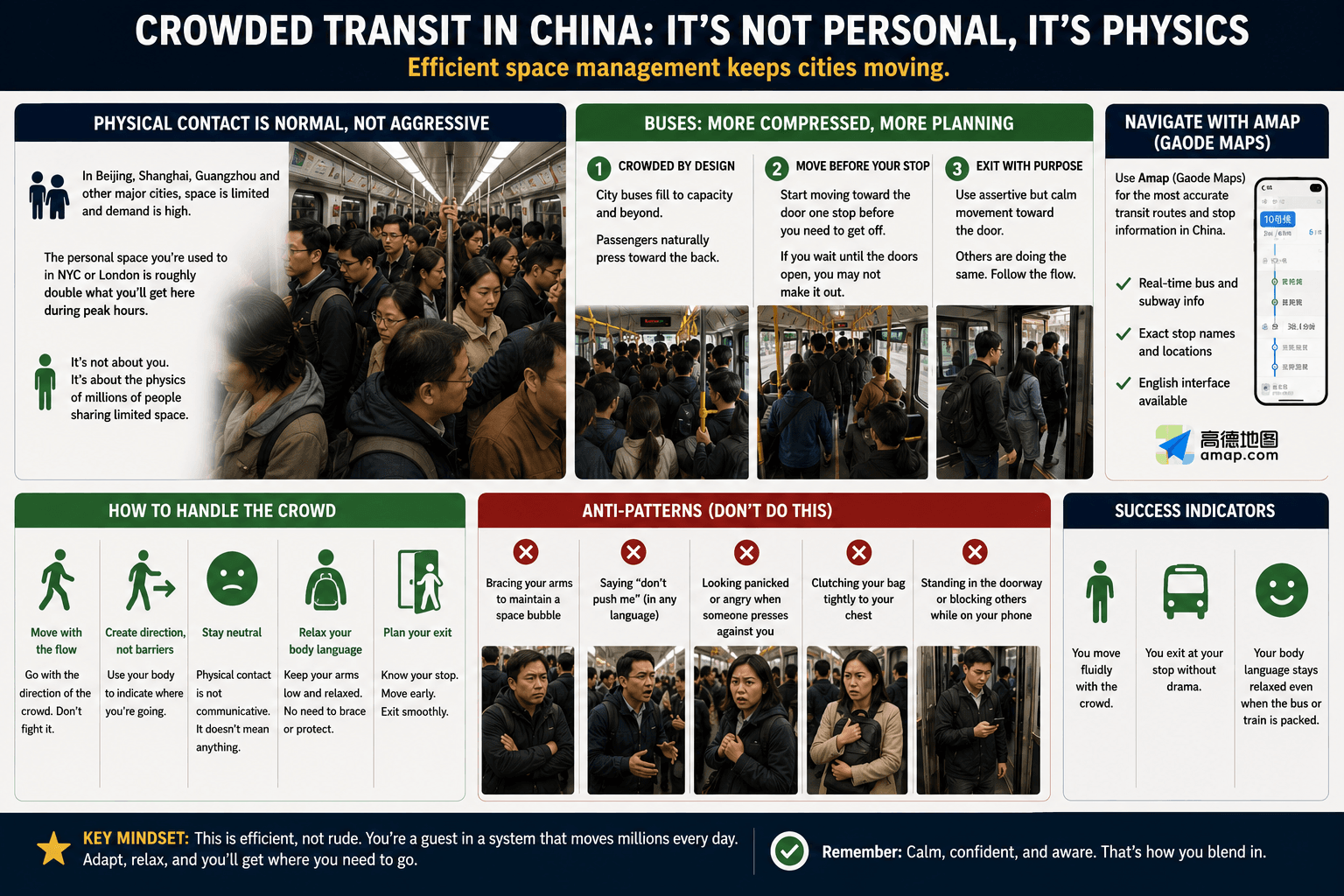
Anti-patterns: Bracing your arms to maintain a space bubble. Saying “don’t push me” (in any language). Looking panicked or angry when someone presses against you. Clutching your bag to your chest in a way that suggests you think you’re about to be robbed (this reads as insulting).
Success indicators: You move fluidly with the crowd. You exit at your stop without drama. Your body language is relaxed even when the car is packed.
Step 6: Read the Escalator and Walking Norms
Objective: Move through stations and public spaces at the expected pace and in the expected lanes.
The escalator convention in most Chinese metro systems is stand on the right, walk on the left. This is the same as London and many other cities. But enforcement is inconsistent, and during rush hour, both sides may be standing-only because the volume of people makes walking up impractical. Don’t get frustrated if the left lane is blocked. It’s not a violation; it’s a density response.
Walking speed in Chinese transit stations is generally faster than what visitors expect. Stopping to look at your phone, check a map, or take a photo in the middle of a corridor creates an obstacle. Step to the side, against a wall, out of the flow. This is one of the simplest and most impactful things you can do to avoid being “that tourist.”
For a comprehensive walkthrough of escalator rules, security procedures, and boarding logistics , the full metro guide covers the mechanical details step by step.
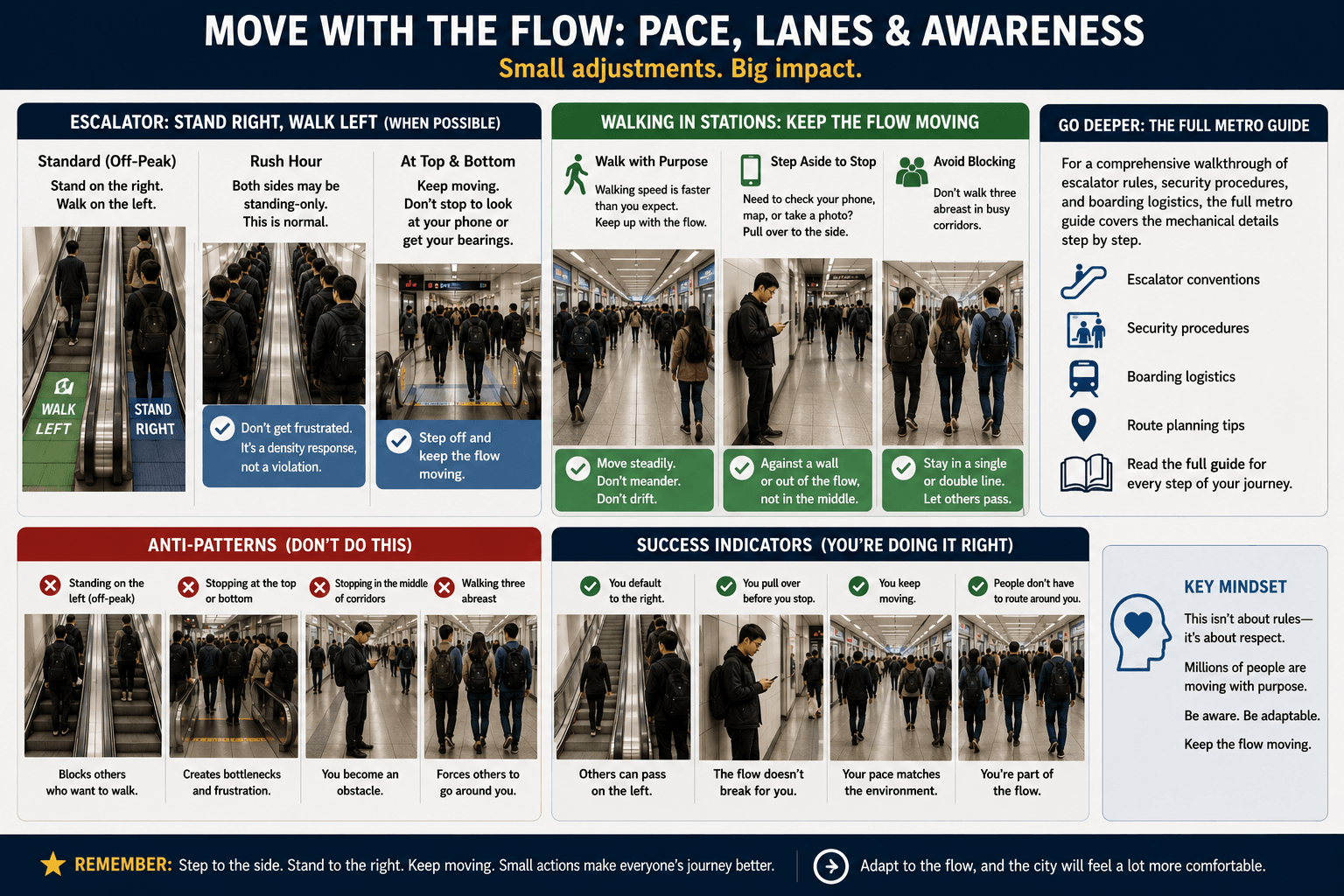
Anti-patterns: Standing on the left side of an escalator during off-peak hours. Stopping at the top or bottom of an escalator to get your bearings. Walking three abreast with travel companions in a busy corridor.
Success indicators: You default to the right on escalators. You pull over before checking your phone. People don’t have to route around you.
Practical Examples: Scenarios You’ll Actually Encounter
Scenario 1: The Rush Hour Board
It’s 8:15 a.m. on Beijing Line 10. The platform is packed three rows deep. The train arrives. Doors open. A wave of people exits. Before the last person is fully out, boarding begins from both sides. You hesitate for two seconds. The gap closes. You don’t board. The next train is 90 seconds away.
What to do differently: Position yourself at the floor markings before the train arrives. When exiting passengers thin to the last few, begin moving forward with the boarding group. Match the pace of the people around you. You don’t need to push, but you do need to not hesitate.
Scenario 2: The Speakerphone Grandma
You’re on a Chengdu bus. The woman next to you is having a loud video call with what appears to be her grandchild. The volume is at maximum. She’s laughing. The call lasts twelve minutes. Nobody else on the bus reacts at all.
What to learn: The absence of reaction from other passengers is the norm. This is not a case of everyone being too polite to say something. Nobody is bothered because this behavior falls within the expected range. Your discomfort is real, but it’s generated by your expectations, not by the behavior itself.
Scenario 3: The Seat Offer
You’re sitting on the Shanghai Metro. An elderly man boards. You stand and gesture to your seat. He shakes his head and waves his hand. You remain standing awkwardly. He remains standing. Two stops later, a younger Chinese woman stands and offers her seat with a quick nod. He sits.
What happened: Nothing went wrong. He may have refused your offer because you were a foreigner and he felt self-conscious, or because he was only going one stop, or for no particular reason. The second offer worked because it was briefer and less conspicuous. Don’t overthink refusals. Offer, accept the response, move on.
Public Transportation Etiquette: Common Mistakes and Pitfalls
The most predictable failure mode is moral judgment. Visitors who frame Chinese public behavior as “rude” or “uncivilized” are not just wrong; they’re blocking their own ability to adapt. The behavior makes sense within its context. Your job is to understand the context, not to grade it.
A close second: over-apologizing. Saying “sorry” every time someone brushes against you or you need to move through a crowd reads as strange, not polite. In dense transit environments, movement is expected. You don’t need to apologize for existing in a space.
Third: freezing. When you don’t know what to do, the instinct is to stop moving. In a Chinese transit station, stopping is the worst option. Keep moving, even if you’re not sure where you’re going. You can correct course in motion. You can’t correct course as a stationary obstacle in a river of commuters.
Finally, don’t assume uniformity. Shanghai’s norms are not Chengdu’s norms. A tier-one city subway is not a rural bus. Stay observant. The best etiquette guide is the behavior of the people around you right now.
What to Do Next
Start with one principle: watch before you act. Your first ride on a Chinese subway or bus, spend the entire trip observing. Watch how people board. Watch what they do with their phones. Watch how they exit. Watch who stands for whom. You’ll learn more in ten minutes of observation than from any guide, including this one.
Then, on your second ride, participate. Match the pace. Match the volume. Match the flow. You won’t get it perfect, and that’s fine. The goal isn’t to pass as a local. The goal is to move through the system without friction, for yourself or for anyone else.
If you’re planning your first trip, ChinaTravelMag covers the practical logistics (apps, payments, navigation) that sit underneath the cultural layer this guide addresses. Get the infrastructure sorted before you arrive, and the social calibration becomes much easier.
Revisit this guide after your first few days. The scenarios that felt abstract will suddenly feel specific. That’s when the real learning starts.
Frequently Asked Questions
Sources
- https://www.novo-monde.com/en/subway-beijing/
- https://www.babagoeschina.com/public-transport-in-china/
- https://chinatravelmag.com/the-essential-apps-that-replace-your-credit-cards-google-maps-and-english-menus-before-you-leave-the-hotel/
- https://chinatravelmag.com/navigating-china-why-amap-is-your-ultimate-travel-companion/
- https://chinatravelmag.com/chinese-metro-guide-security-alipay-escalator-rules-local-tips/
- https://www.chinatravelmag.com